

The Core Elements of Effective Law Firm Branding
Law firm branding is how your firm shapes client perception through your visual identity, messaging, values, and every interaction, from your website to your business card to the way you answer the phone. It’s the emotional connection clients build with your firm before they ever schedule a consultation.
What is law firm branding and why does it matter?
- Definition: The deliberate process of shaping how clients and prospects perceive your firm through consistent visual identity, messaging, and client experience.
- Key elements: Mission and values, visual identity (logo, colors, typography), brand voice, online presence, and reputation.
- Why it’s crucial: With 449,633 law firms in America as of 2023, strong branding helps you stand out, build trust, and attract ideal clients. According to Statista, the legal services market in the U.S. continues to grow, making differentiation more difficult than ever.
- What clients really want: Many prospects prioritize reputation, relevant experience, and positive reviews far more than low rates.
- Bottom line: Branding isn’t just for big firms. Solo and small firms can outperform larger competitors through consistent, authentic branding.
Most law firm websites still look the same: generic courthouse photos, eagle logos, and vague promises of “aggressive representation” or “client-focused service.” Those are table stakes. To actually differentiate, your firm has to align what it looks like with what it stands for and how it feels to work with you.
The Psychology of the Legal Consumer
Branding done right changes how potential clients see you before they ever contact you. In high-stakes legal matters, prospects are often stressed, overwhelmed, and searching for a clear next step. According to research on the psychology of branding, consumers make decisions based on emotional resonance and the reduction of cognitive load. Your brand should signal stability, competence, and empathy across every touchpoint so the first impression matches the actual experience.
Today, most discovery happens online. Your website, reviews, and social presence often act as your first consultation. And because clients increasingly compare firms side-by-side in search results, consistency matters: a high-end website paired with a confusing intake process creates a credibility gap. When a brand feels fragmented, it creates subconscious doubt in the prospect’s mind regarding the firm’s ability to handle complex legal details.
I’m Nicole Farber, founder of ENX2 Legal Marketing. Over the past 12 years, I’ve helped law firms move from forgettable to unmistakable through strategic law firm branding that supports growth. Below is the practical framework we use to build brands that attract the right clients and earn trust quickly.
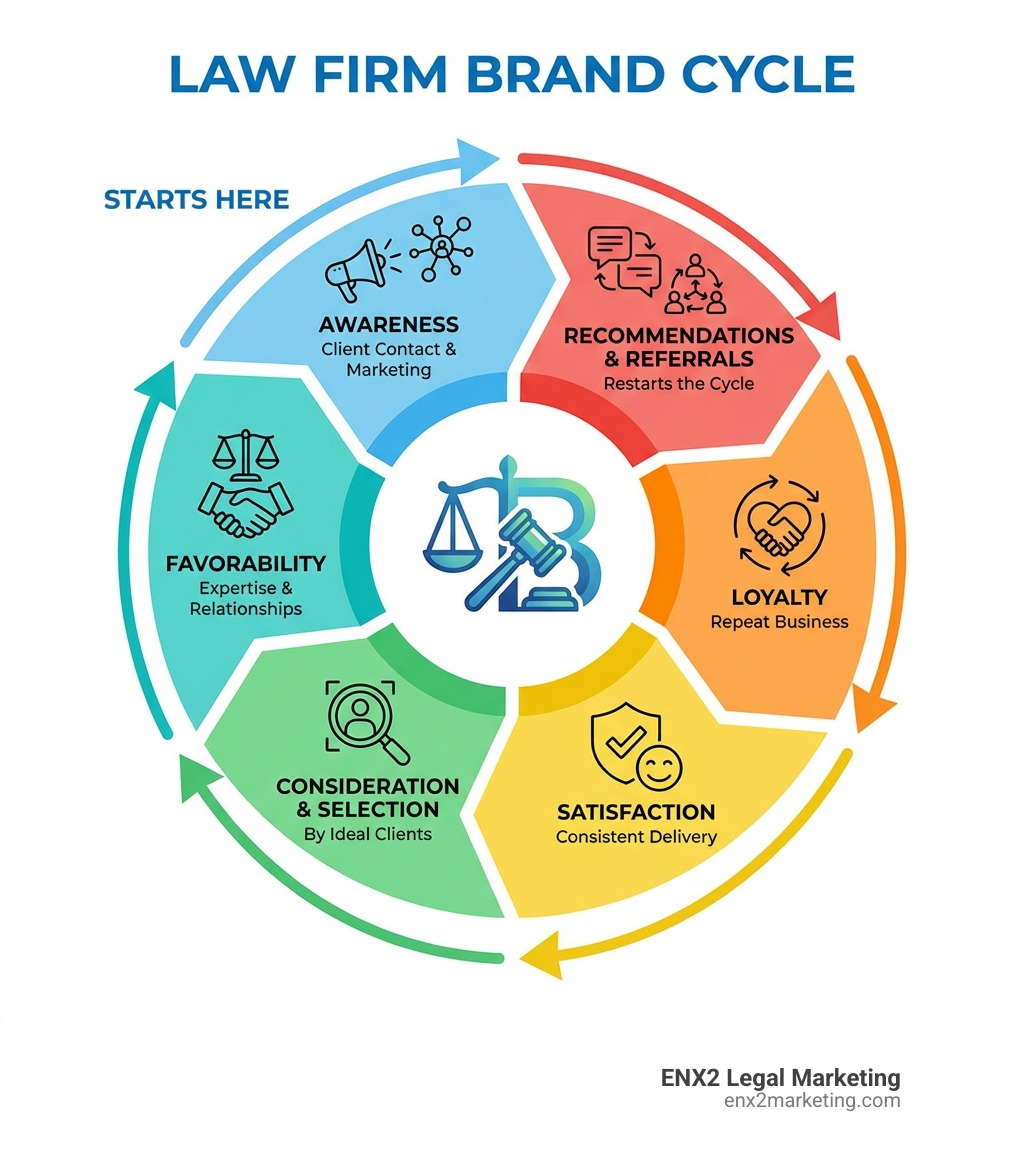
Law firm branding vocabulary:
Defining Your Mission and Unique Selling Proposition (USP)
When we talk about law firm branding, we are talking about more than a logo. It’s the sum of every client-facing detail and the reputation those details create over time. Research from the Harvard Law School Center on the Legal Profession frames brand as a strategic tool that can create durable competitive advantage.
You can’t communicate your brand clearly if you haven’t defined it. Start by clarifying who your firm is for, what you do best, and how you want clients to describe you after the matter is resolved. This becomes your unique selling proposition (USP).
At ENX2 Legal Marketing, we believe branding for law firms begins with values and focus. Are you the direct, trial-ready litigators? The patient, detail-driven counselors? The mission statement should function as a brand promise that guides client service, not just a line on a plaque. To define your niche, ask:
- Who is our ideal client, specifically?
- What problem do we solve better than anyone else in our market?
- What do we want clients to say about us to a friend?
- What expectations should our brand set before the first call?
Designing a Visual Identity: Law Firm Branding Beyond the Logo
Once the strategy is clear, visuals can reinforce it. A common mistake is choosing a generic law firm logo (gavels, scales, pillars) that blends into the background. Effective law firm logo design uses color psychology and typography to evoke the right emotion. Navy often signals stability; burgundy can suggest tradition and authority; forest green can imply renewal and growth. We often advise clients on using color to define your brand because color is processed quickly and can influence perceived credibility before a word is read.
Typography matters too. Serif fonts can feel established; sans-serif fonts can feel modern and efficient. Pair that with a short, specific tagline that reflects your audience’s real concern. Furthermore, the use of professional, custom photography—rather than generic stock images—is essential. High-quality portraits of your team in their actual environment humanize the firm and build an immediate sense of familiarity and trust.
Building Trust Through Online Presence and Reviews
In a digital-first market, your brand lives online. A cohesive presence typically includes:
- A mobile-friendly website: If the site is slow or confusing, prospects often assume the firm is outdated or disorganized.
- SEO: Visibility for your practice area and location supports authority and helps the right clients find you.
- Social media: A channel to humanize the firm and reinforce voice and values. We’ve seen how social media branding is important when firms use it consistently.
- Reviews: Social proof validates your claims. Prospects often use reviews to narrow down who they will contact.
Whatever the practice area, the goal is the same: reduce uncertainty. Clear messaging, helpful content, and a professional design all work together to earn the first call.
Leveraging Personal Branding and Content Marketing
People hire lawyers, not logos. That’s why lawyer branding and thought leadership can be so powerful. Content marketing is most effective when it educates instead of sells. For example, an employment lawyer who publishes plain-English guidance on workplace changes will often earn trust before a consultation is ever booked. For practical guidance on aligning tone and positioning, see HubSpot’s resource on Developing brand messaging.
Strong content also improves organic visibility, supports email campaigns, and gives your attorneys better material for LinkedIn and speaking engagements. By positioning your attorneys as subject matter experts, you transition the firm from a service provider to a trusted advisor.
Common Law Firm Branding Mistakes to Avoid
Even good firms fall into predictable branding traps. One of the most important constraints is ethical compliance. The American Bar Association (ABA) rules on communications about a lawyer’s services require that messaging not be false or misleading or create unjustified expectations.
Common pitfalls:
- The “me-too” brand: Stock visuals and interchangeable copy.
- Inconsistency: Modern website, outdated print collateral, mismatched tone.
- Ignoring feedback: Not tracking what reviews, surveys, and call recordings reveal.
- Logo-first branding: Designing visuals before you define positioning.
- Multi-jurisdiction confusion: Inconsistent firm naming or disclosures across states.
For more on the moves firms can’t afford to miss, see Beyond the Logo: 7 Branding Moves Law Firms Can’t Afford to Miss.
Enhancing Client Experience with Legal Tech
Your brand is a promise; the client experience is the proof. If your brand signals efficiency but intake is slow or confusing, prospects feel the disconnect. Legal tech can reinforce a responsive, organized brand when implemented correctly. Platforms like Clio or Rocket Matter can support smoother intake, clearer billing, and better communication workflows. As noted in Speaker’s Corner: Satisfaction and loyalty, meeting and managing expectations is central to client satisfaction and loyalty.
Legal tech branding boosters:
- CRM systems: Reduce missed leads and improve responsiveness.
- Automated booking: Shows respect for client time.
- Call tracking and analytics: Connect marketing performance to intake outcomes.
- Educational resources: Thought leadership assets like guides, checklists, and whitepapers can be part of a broader content strategy (including commissioned writing such as a custom law essay when appropriate).
Measuring Success and Evolving Your Brand
Branding is an ongoing investment, not a one-time project. We recommend a brand audit every 12-18 months to confirm you’re still aligned with your market, your practice mix, and how clients actually choose counsel. As noted by Entrepreneur, a comprehensive brand audit allows you to identify where your brand stands in the marketplace and how to adjust for future growth.
How do you know if your law firm branding is working? Measure the signals that reflect trust and fit, not just traffic. Key metrics we track at ENX2 Legal Marketing include:
- Lead quality: Are you attracting the matters and clients you actually want?
- Conversion rate: Are more prospects booking consultations after visiting your site?
- Branded search volume: Are more people searching for your firm by name (a strong indicator of awareness and recall)?
- Reputation trends: Review volume, rating stability, and how you respond.
- Intake performance: Speed to answer, missed calls, and follow-up consistency.
As a premier SEO agency for lawyers, we connect brand visibility to measurable outcomes, using analytics and call tracking to see what messaging and channels are truly driving signed cases.
A useful example of brand evolution is the Meyerson & O’Neill Law Firm Case Study. By redesigning their website and clarifying specific litigation niches, they increased new visitors and improved lead volume quickly. The win wasn’t just a new design, it was sharper positioning.
The Internal Brand: Your Team as Brand Ambassadors
One often overlooked aspect of law firm branding is the internal culture. Your staff—from the receptionist to the senior partner—must embody the brand values in every interaction. If your brand promise is “compassionate advocacy,” but a client receives a cold or dismissive response from the front desk, the brand is instantly compromised. Internal branding involves training your team to understand the firm’s USP and ensuring they have the tools to deliver on that promise consistently. When your team believes in the brand, they become its most effective ambassadors, naturally reinforcing your reputation through their daily work.
Your brand audit checklist:
- Visual alignment: Do the logo, colors, and typography match the caliber of clients you want?
- Messaging consistency: Does the same voice appear on your website, LinkedIn, print materials, and email signatures?
- Reputation health: Are reviews and responses reinforcing your values and professionalism?
- Operational delivery: Do intake, communication, and billing match the brand promise?
- Internal buy-in: Do attorneys and staff understand and deliver the experience you market?
- Competitive positioning: Side-by-side with local competitors, do you look clearly different for the right reasons?
Brand Equity and Long-Term Value
Ultimately, a strong brand builds “brand equity”—the commercial value that derives from consumer perception of the brand name of a particular product or service, rather than from the product or service itself. For a law firm, this means that your name alone can command higher fees, attract top-tier talent, and generate a steady stream of referrals. Investing in your brand today creates a tangible asset that increases the long-term valuation of your firm, making it more resilient to market fluctuations and more attractive should you ever decide to merge or sell.
If any answer in your audit is “no,” your brand may be costing you good cases. ENX2 Legal Marketing helps firms in Pennsylvania (including Wilkes-Barre and Scranton) and across markets like Washington DC, New York, California, and Tennessee build clear positioning, modern creative, and data-backed growth systems.
Ready to see what your current branding signals to potential clients? Contact ENX2 Legal Marketing to schedule a brand and website review.