

Why Your Law Firm’s Digital First Impression Matters More Than Ever
In today’s digital marketplace, an attorney website redesign is a matter of survival. Your website is the first impression potential clients have of your firm, and that judgment happens in the blink of an eye. The stakes couldn’t be higher: 75% of users judge a site’s credibility on design alone, and that impression forms in just 1/20th of a second (see G. Lindgaard et al., 2006: https://doi.org/10.1145/1166253.1166260). Independent usability research also shows that visual design and clarity strongly influence perceived trustworthiness online: https://www.nngroup.com/articles/trust-guidelines/.
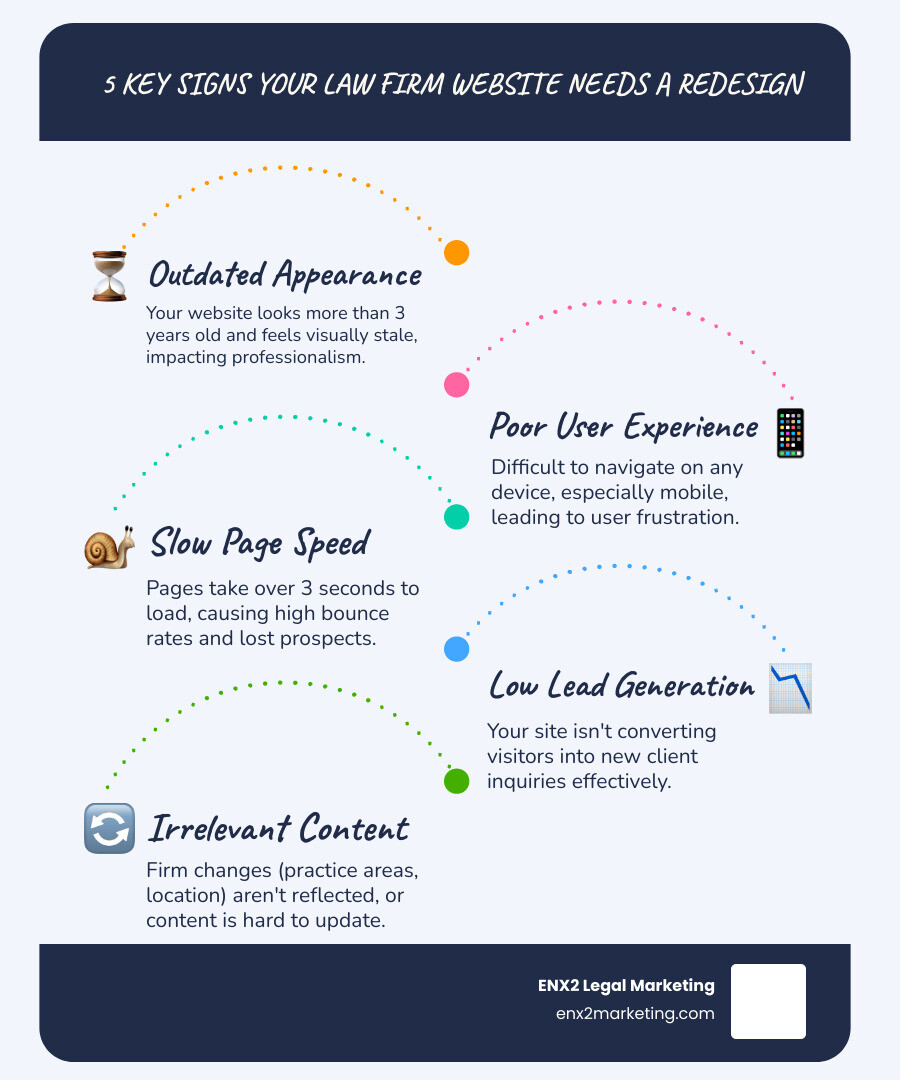
Key indicators your law firm needs a website redesign:
- Outdated appearance – Site looks more than 3 years old
- Poor mobile experience – Difficult to steer on smartphones
- Slow loading times – Takes longer than 3 seconds to load
- Low lead generation – Not converting visitors into clients
- Navigation issues – Hard to find information or contact details
- Firm changes – New practice areas or attorneys not reflected
Your website is your 24/7 digital storefront. If it’s outdated or slow, you’re driving clients to your competition. With more than 33% of people starting their attorney search online, your site’s performance is critical. I’m Nicole Farber, CEO of ENX2 Legal Marketing. With over 12 years of experience, I’ve seen how a strategic redesign can transform a firm’s digital presence into a powerful client acquisition tool. This guide will walk you through making your redesign a success.
The Case for an Attorney Website Redesign: Signs, Stakes, and Solutions
A website redesign can feel overwhelming, but in today’s legal market, an effective website is essential for growth. Think of your site as your most important employee—one that works 24/7. If it’s underperforming, it’s hurting your firm. Let’s review the warning signs, the high cost of delay, and the key elements of a successful law firm website.
Key Signs Your Attorney Website Redesign is Overdue
Websites typically need a refresh every two to three years, but beyond the calendar, these clear warning signs indicate your site is holding your firm back:
- Outdated Aesthetics: If your site looks over three years old, it suggests your firm isn’t current or successful.
- Poor User Experience (UX): Confusing navigation and broken links frustrate visitors. 88% of users won’t return after a bad experience.
- Slow Page Speed: In a world of instant gratification, every second counts. According to Google research, 53% of mobile users abandon a site that takes longer than 3 seconds to load (source: https://www.thinkwithgoogle.com/marketing-strategies/app-and-mobile/mobile-page-speed-statistics/). This is why website speed matters so much. For developers, Google’s Core Web Vitals are a helpful framework: https://web.dev/vitals/.
- Mobile Unfriendliness: With nearly 60% of internet users on mobile, a non-responsive site alienates most of your audience. Our guide on the mobile site vs browser site explains why optimization is non-negotiable. For how Google indexes mobile content, see: https://developers.google.com/search/mobile-sites/mobile-first-indexing.
- Low Lead Generation: Your website’s primary job is to convert visitors into clients. If it’s not generating calls or form submissions, it’s failing.
- Difficult Content Updates: If you need a developer for simple updates like adding a blog post, your site’s technology is outdated.
- Firm Changes: Your website must accurately reflect new partners, practice areas, or locations.
- Competitor Websites: If your competitors’ sites look more professional, you’re likely losing business to them.
The High Cost of an Outdated Website
Ignoring these signs is costly. An outdated website damages your firm’s reputation and bottom line. 75% of users judge a site’s credibility on its design alone, and 57% won’t recommend a business with a poorly designed website. The most painful consequence is lost clients: 89% of prospective clients will choose a competitor after a bad website experience. This leads to higher bounce rates, which hurts your search engine rankings, creating a vicious cycle where your firm becomes invisible to a huge segment of potential clients. If your website isn’t effective, your firm might as well not exist.
Essential Elements of a Modern, High-Converting Law Firm Website
A successful attorney website redesign is a strategic project that attracts the right clients and builds immediate trust. Here are the essential elements:
- Modern, Professional Design: Reflect your firm’s authority with clean layouts and contemporary typography.
- Intuitive User Experience (UX): Guide visitors effortlessly with clear navigation and fast loading times.
- Robust Search Engine Optimization (SEO): Ensure potential clients can find you through search engines.
- Mobile-First Responsive Design: Your site must function flawlessly on all devices, as Google prioritizes mobile-optimized sites.
- Clear Calls-to-Action (CTAs): Guide visitors to schedule a consultation or contact your firm.
- Compelling Content: Build trust with professional attorney bios, comprehensive practice area pages, and authentic client testimonials.
- Professional Media: High-quality photography and videography set you apart.
- Technical Excellence: Ensure accessibility (ADA compliance) and security (SSL certificate) to build trust and protect your firm. For accessibility standards, review WCAG guidance from W3C: https://www.w3.org/WAI/standards-guidelines/wcag/.
Building an effective legal website requires specialized expertise, which is why the ABA’s 2023 Websites & Marketing TechReport found that 42% of firms outsource website design. For more insights, explore our guide on the best law firm web design.
Navigating the Redesign Process: From Planning to Launch
A successful attorney website redesign is a strategic investment. Proper planning is the key to avoiding unexpected costs, delays, and disappointing results. Let’s walk through the essential stages to ensure your project’s success.
Planning Your Attorney Website Redesign: Budget, Timeline, and Design Options
Understanding Your Investment & Timeline
A professional redesign for a law firm typically costs between $5,000 and $20,000, with complex projects for larger firms costing more. Factors like firm size, page count, and custom features influence the price. The timeline can range from 3 weeks to 6 months, with an average of around 75 days. Delays are often caused by excessive revisions or slow client feedback, so designating a single point of contact is crucial for keeping the project on track. For more details, see our guide on How Much Are Attorney Websites?.
Choosing Your Design Approach
Your choice of design impacts cost, timeline, and uniqueness. This table breaks down the common options:
| Design Type | Cost Range | Timeline | Uniqueness | Flexibility | Best For |
|---|---|---|---|---|---|
| Template | $500-$3,000 | 2-4 weeks | Limited | Basic | Solo practitioners with tight budgets who need a quick online presence |
| Semi-Custom | $3,000-$10,000 | 6-10 weeks | Moderate | Good | Small to mid-size firms wanting professional appearance with some customization |
| Fully Custom | $10,000-$50,000+ | 12-24 weeks | High | Excellent | Established firms needing distinctive branding and advanced functionality |
While templates are affordable, they lack uniqueness. A semi-custom approach offers a balance, but for firms needing distinctive branding and advanced features, a Custom Law Firm Web Design delivers the most effective results.
Choosing the Right Partner for Your Redesign
Selecting an agency that understands the legal industry is critical. Not all web designers grasp the ethical rules and marketing challenges specific to law firms.
What to Look for in an Agency:
- Law Firm Specialization: They should understand attorney advertising rules and what converts legal clients.
- Strong Portfolio: Look for high-quality sites for firms similar to yours.
- Proven Results: Ask for client testimonials, case studies, and references.
- SEO Expertise: The agency must know how to build a site that ranks well in search and preserve your existing rankings during the transition (including a comprehensive 301-redirect map and site-migration plan per Google’s guidance on site moves: https://developers.google.com/search/docs/crawling-indexing/site-move-with-url-changes).
- Understanding of Legal Ethics: This is non-negotiable. Your website is a form of advertising and must comply with your state bar’s rules of professional conduct. An agency unfamiliar with these rules could inadvertently create compliance issues for your firm. For example, rules often govern the use of client testimonials, claims of specialization, and language that could create unjustified expectations. You can review the American Bar Association’s Model Rules on advertising for a foundational understanding (see Rules 7.1 through 7.5: https://www.americanbar.org/groups/professionalresponsibility/publications/modelrulesofprofessionalconduct/rule71communicationsconcerningalawyers_services/).
Key Questions to Ask Potential Partners:
- What is your experience with firms in my practice area?
- How will you handle SEO and content migration?
- What is your project management and communication process?
- What post-launch support do you offer?
- What is the project timeline and what could cause delays?
Finding the right partner is a crucial step. For more guidance, read our article on How to Choose the Best Digital Marketing Agency for Your Law Firm. A great partner acts as an extension of your team, working to achieve your firm’s growth goals.