

Why Your Firm’s Identity is Your Greatest Asset
Branding for law firms is the strategic process of defining and communicating your firm’s unique identity to build trust, differentiate from competitors, and attract ideal clients. In today’s crowded legal marketplace, your brand is the foundation for all client relationships and business growth.
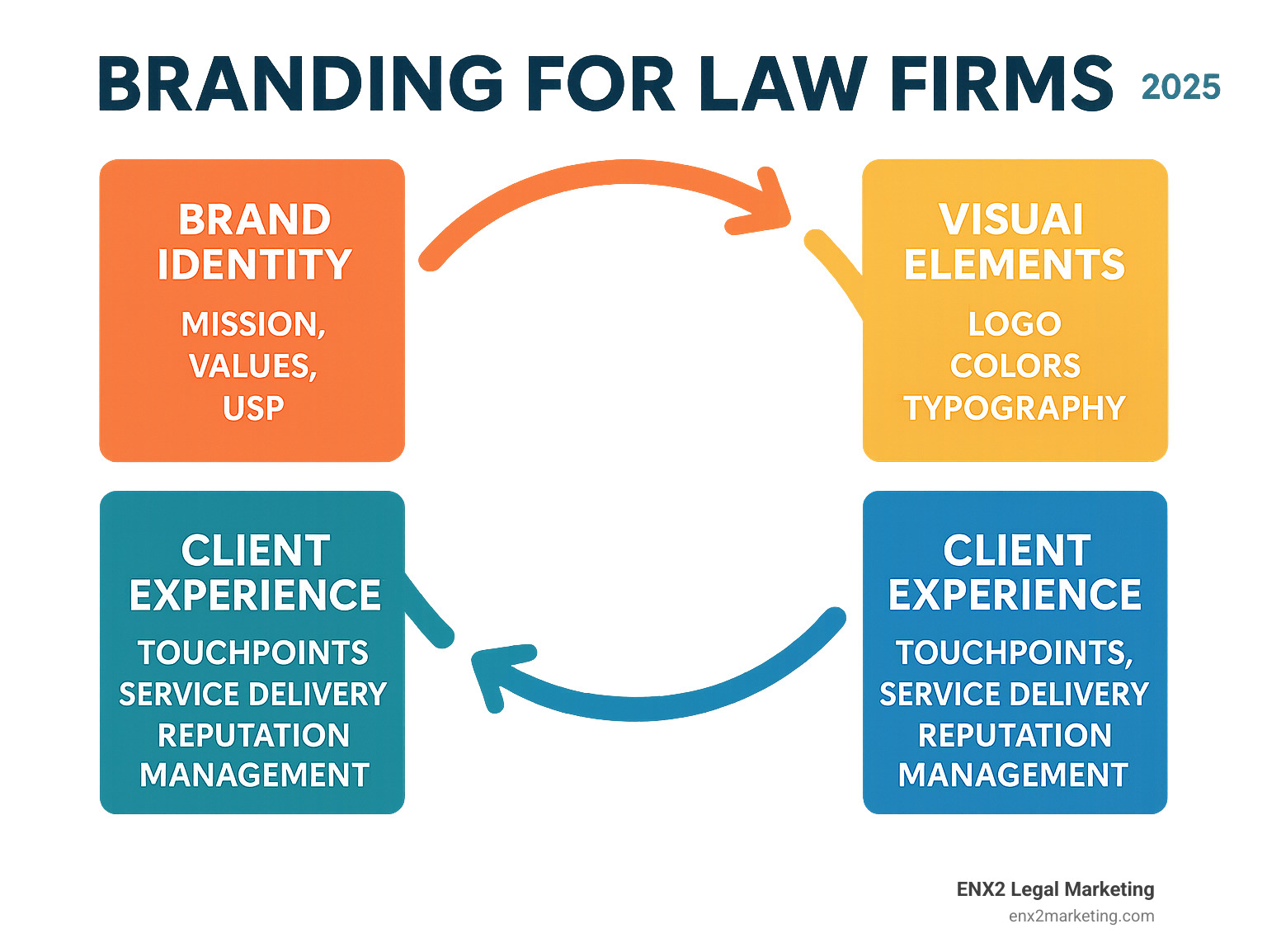
Key components of effective law firm branding include:
- Brand Identity: Your mission, values, and unique selling proposition (USP).
- Visual Elements: Logo, colors, typography, and design consistency.
- Messaging: Brand voice, taglines, and communication style.
- Client Experience: How clients perceive and interact with your firm.
- Online Presence: Your website, social media, and digital reputation.
The statistics are compelling. Research shows 43% of clients prioritize reputation when choosing a law firm, while only 16% care most about low hourly rates. Your brand isn’t just a logo; it’s the complete emotional impression clients have of your firm. When, as research from Headstream shows, buyers are 55% more likely to purchase something in the future if the brand message resonates with them, the importance of strategic branding becomes crystal clear.
I’m Nicole Farber, and over the past 12 years building ENX2 Legal Marketing, I’ve helped countless law firms transform their practices through strategic branding for law firms that drives real results. My experience has shown that firms with strong brand identities consistently outperform their competitors in client acquisition and retention.
A Strategic Guide to Branding for Law Firms
Building a powerful brand for your law firm is an ongoing journey that starts from deep within your firm and radiates outward. This guide to branding for law firms will help you create an authentic identity that resonates with your ideal clients and sets you apart.
Defining Your Core Identity: Mission, Values, and USP
Before designing logos or taglines, you must clarify who you are as a firm. Many firms rush this foundational step, thinking branding is just a logo or a website. In reality, it’s the complete emotional and experiential impression clients have of your firm. Since buyers are 55% more likely to purchase something in the future if the brand message resonates with them, getting this right is essential.
Your Foundation: Mission, Values, and What Makes You Unique
Your mission statement is your firm’s North Star—it explains why you exist beyond making money. For example, a family law firm’s mission might be: “We guide clients through life’s most challenging transitions with compassion, clarity, and unwavering advocacy.”
Your core values (e.g., integrity, client-first service, innovation) are the principles guiding every decision. Crucially, they must genuinely reflect how your firm operates.
Your unique selling proposition (USP) is what truly differentiates you. A powerful framework is: “We help [SPECIFIC AUDIENCE] achieve [SPECIFIC TRANSFORMATION] through [YOUR UNIQUE APPROACH].” Instead of a generic “experienced family lawyers,” try: “We help high-net-worth families protect their assets and children’s futures through discreet, strategic divorce representation.” You can learn more about crafting a compelling USP in this comprehensive guide from Forbes.
Getting to Know Your Audience
You can’t build a resonant brand without deeply understanding your ideal clients’ motivations, fears, and decision-making processes. 43% of clients prioritize reputation and 40% focus on experience with similar cases—not just low rates. The best way to gather this intelligence is to ask your clients directly through surveys or interviews. Ask questions like, “What was your biggest concern when searching for legal help?” and “What convinced you to choose our firm?”
Analyzing Your Competition
Competitor analysis isn’t about copying; it’s about finding opportunities to be different. Review other firms’ websites and marketing. What messages are they emphasizing? What visual styles do they use? Look for gaps. If everyone uses traditional imagery and formal language, a modern, approachable brand identity could be your chance to stand out.
Crafting Your Visual and Verbal Identity
Once your core identity is solid, bring it to life through visual and verbal elements. This is where your brand transforms from an internal concept to an external force.

Creating Memorable Visual Elements
Your logo is often a client’s first impression, so it must be simple, memorable, and versatile. Avoid clichéd legal imagery like gavels and scales unless you have a compelling creative twist. Color psychology also plays a key role. While deep blues convey trust and professionalism, some modern firms use warmer colors to stand out. Typography matters, too. Serif fonts feel traditional, while sans-serif fonts appear more modern and approachable. Your choices should align with your brand’s personality.
Developing Your Brand Voice and Messaging
Your brand voice is your firm’s personality in words. Are you authoritative but approachable? Compassionate yet confident? This voice must be consistent across your website, social media, and client emails. Your website is especially critical, as 81% of small firms and 69% of solo firms use it as a key marketing channel. It must be professional, mobile-friendly, and filled with clear calls to action that reinforce your brand. That’s why we developed our comprehensive Law Firm Website Design services—to ensure your online presence perfectly reflects your brand.
The Synergy of Brand, Reputation, and Personal Branding
Your firm’s brand works hand-in-hand with your reputation and the personal brands of your attorneys.
The Brand-Reputation Connection
Think of your brand as the promise you make and your reputation as proof that you deliver. A strong brand sets expectations; a strong reputation confirms you meet them. Since reputation matters to 43% of clients and positive reviews influence 30%, every client interaction is a chance to strengthen this connection.
Leveraging Personal Branding
Individual attorneys are often the face of the firm. When they build personal brands as thought leaders through speaking, writing, or social media, they build credibility that extends to the entire firm. Personal branding humanizes your practice, making it more relatable. The key is ensuring individual brands align with the firm’s overall message, creating a cohesive and powerful identity.
Common Mistakes and Modern Solutions in branding for law firms
Even well-intentioned firms can stumble. Recognizing common pitfalls can save you time and money.

The Biggest Branding Mistakes
The most common mistakes include using generic legal imagery, copying competitors, and having inconsistent messaging and visuals. A disjointed brand with a polished website but outdated letterhead looks unprofessional. Many firms also neglect their online presence or ignore client feedback, making them invisible to potential clients.
Modern Solutions
Modern legal technology and digital marketing offer powerful solutions. Your branding for law firms strategy must integrate with your digital marketing, including SEO, content marketing, and social media. Since more than 40% of firms rely on social media, a coordinated approach is essential. Our team specializes in Digital Marketing for Law Firms, ensuring your brand message reaches the right people through the right channels.
Successful Strategies and the Evolution of branding for law firms
Successful brands understand that evolution is necessary to stay relevant.
Learning from Success Stories
Successful brands often exhibit niche-focused clarity (like Silver Immigration), values-driven messaging (like Hemmat Law Group), or a modern aesthetic that speaks to a specific clientele (like Output Law). These firms prove that a clear, authentic brand is a powerful differentiator.
How Brands Evolve
Branding for law firms is a marathon, not a sprint. Review your brand every 12-18 months to refine messaging or update visuals. Major firm changes—like mergers or new leadership—often require a more significant brand evolution. A brand that felt modern five years ago may seem outdated today. Measuring success through metrics like client inquiries, online reviews, and website engagement will show if your brand is working. The firms that thrive view branding as an ongoing investment in their future.
Conclusion: Forging a Lasting Legacy
Building a strong brand for your law firm is about creating a foundation for decades of success. As we’ve explored, effective branding for law firms is a comprehensive strategy that moves far beyond a simple logo or color scheme.
The journey starts with defining your core identity—your mission, values, and USP—to give clients a compelling reason to choose you. This identity is then brought to life through a cohesive visual and verbal style that creates a powerful emotional connection. This connection is crucial, as studies confirm that buyers are 55% more likely to purchase from a brand whose message resonates with them.
By aligning your firm’s brand with your reputation and the personal brands of your attorneys, you create a multiplier effect of trust and credibility. A well-crafted brand helps you avoid common pitfalls like generic messaging and inconsistency, while modern digital strategies amplify your message. Brands must evolve to stay relevant, ensuring your firm remains competitive.
Building client loyalty, attracting top talent, and creating sustainable growth all flow from a strong brand. It’s how you turn your practice into a legacy.
At ENX2 Legal Marketing, we’ve spent over a decade helping law firms forge powerful identities. We understand that branding for law firms is the foundation for everything you want your practice to become. To start creating a compelling visual identity that represents your firm’s excellence, explore our Law Firm Logo Design services. Your brand is your legacy in the making—choose to build one that lasts.