Understanding the Washington DC Divorce Process: Your Complete Legal Roadmap
A Washington DC divorce can feel overwhelming, but understanding the process makes it manageable. This guide provides a clear roadmap, whether you’re facing an uncontested separation or a complex contested case.
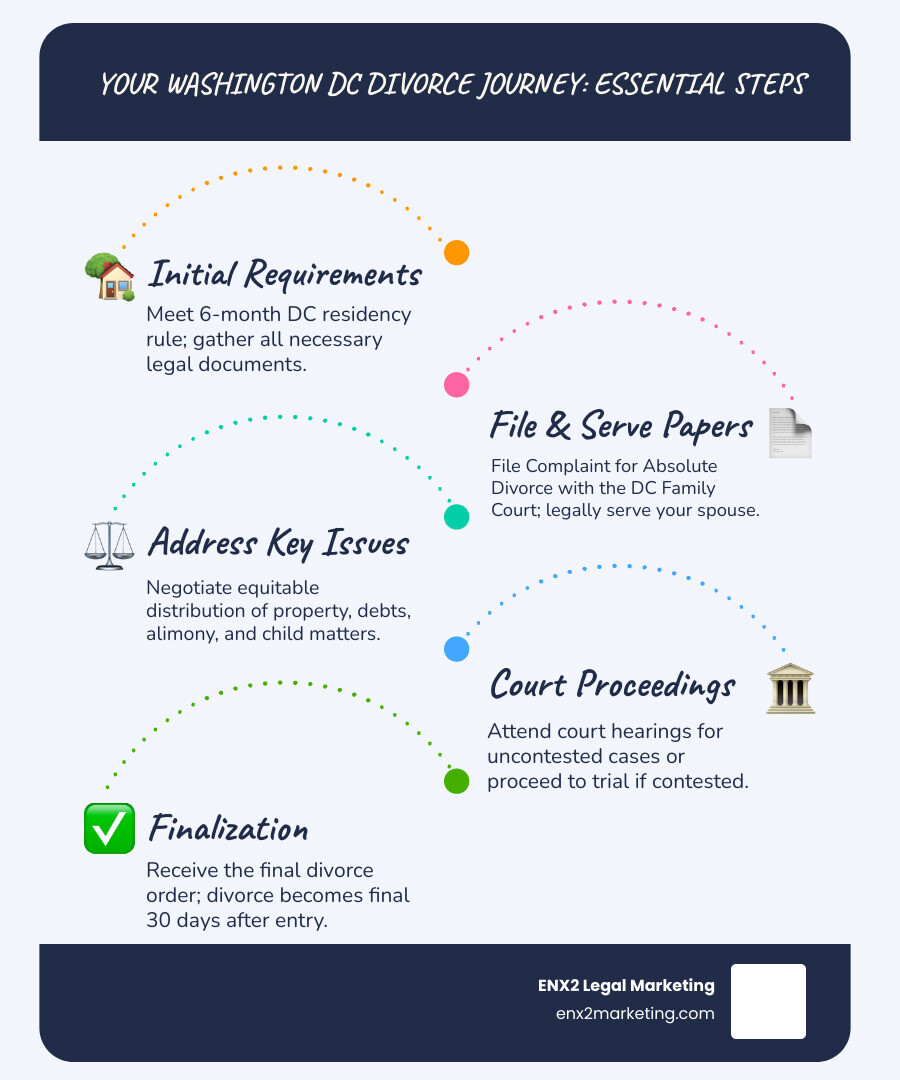
Key aspects of a DC divorce include a six-month residency requirement for at least one spouse and a no-fault system, meaning you only need to prove you’ve lived separately. The process involves filing a Complaint for Absolute Divorce, serving your spouse, and resolving issues like property division, alimony, and child custody before a final order is issued. Uncontested cases can take 2-3 months, while contested ones may last up to 18 months.
The District of Columbia uses an “equitable distribution” model to divide marital property fairly, not necessarily 50/50. For children, DC law presumes joint custody is in their best interest and requires child support until age 21.
At ENX2 Legal Marketing, we specialize in helping family law attorneys effectively market their Washington DC divorce services. Our experience gives us deep insight into the challenges clients face and the importance of clear, accessible legal guidance.
The Complete Guide to a Washington DC Divorce
Navigating a Washington DC divorce requires understanding the key legal steps. This guide breaks down the process, from initial requirements to finalization, to make it less overwhelming.
First Steps: Residency, Grounds, and Legal Separation
Before filing, you must meet D.C.’s legal requirements. The primary rule is residency: either you or your spouse must have lived in the District for at least six continuous months. This rule also applies to military members stationed in D.C.
Washington D.C. is a no-fault divorce jurisdiction, which simplifies the process by not requiring proof of wrongdoing. You can file for divorce based on separation. There are two grounds:
- Mutual and voluntary separation for six months, where both spouses agree to live apart.
- Living separate and apart for one year, which does not require your spouse’s consent.
Interestingly, D.C. law allows for “separation under the same roof.” This means you can fulfill the separation requirement while living in the same home, as long as you lead completely separate lives (e.g., separate bedrooms, finances, and meals). While you don’t need a formal legal separation to get divorced, it is an option for couples who wish to live apart but remain legally married for reasons like maintaining health insurance benefits.
Contested vs. Uncontested: Understanding Your Path
Your divorce will follow one of two paths. An uncontested divorce occurs when you and your spouse agree on all major issues, including property division, alimony, and child custody. This collaborative approach is faster and less stressful, often concluding in just two to three months. You can file paperwork jointly, streamlining the process.
A contested divorce is necessary when you cannot agree on these key terms. The court must then intervene to make decisions. The process is more formal: the filing spouse (plaintiff) serves a Complaint for Absolute Divorce, and the other spouse (defendant) has 21 days to respond. Contested cases can take up to 18 months, involving more legal procedures and potential stress.
However, many contested cases are resolved without a full trial. The D.C. Superior Court’s Multi-Door Dispute Resolution Division offers free mediation services. A neutral mediator can help you and your spouse negotiate an agreement, saving significant time, money, and emotional strain. You can learn more through the D.C. Courts mediation program, and for a broader overview of procedures and timelines, review the D.C. Courts Family Court resources.
Dividing Your Life: Property, Debt, and Alimony
Washington D.C. follows the principle of equitable distribution to divide assets and debts. This means the court aims for a fair, but not necessarily equal, split. Marital property includes nearly everything acquired during the marriage, from real estate to retirement accounts, regardless of whose name is on the title. In D.C., property acquired during separation but before the divorce is final is still considered marital.
Separate property—assets owned before the marriage or received as a sole gift or inheritance—is not subject to division. When dividing marital property, a judge considers factors like the length of the marriage, each spouse’s age and health, their income and earning potential, and their contributions as a homemaker.
Alimony, or spousal support, may be awarded to help a lower-earning spouse maintain financial stability. A court can order temporary support during the divorce proceedings and final alimony for a set period (rehabilitative) or indefinitely. The decision is based on factors similar to those for property division, including the standard of living during the marriage and the requesting spouse’s ability to become self-sufficient. Since 2019, alimony payments are not tax-deductible for the payer or taxable for the recipient.
Protecting Your Children: Custody and Support in a Washington DC Divorce
For divorcing parents, the children’s well-being is the court’s highest priority, guided by the “best interests of the child” standard.

D.C. law operates on a joint custody presumption, favoring arrangements where both parents remain actively involved. Legal custody refers to major decision-making (education, healthcare), while physical custody refers to where the child lives. A judge will consider each parent’s fitness, the child’s relationship with each parent, and the child’s preference (especially for older children). The court encourages parents to cooperate and support the child’s relationship with the other parent.
Child support in D.C. is unique in that it typically continues until a child turns 21. The amount is calculated using child support guidelines that consider both parents’ gross incomes and expenses like childcare and health insurance. For high-income families (combined income over $240,000), judges have more discretion. You can estimate potential payments using the official D.C. child support guidelines calculator.
Finalizing Your Washington DC Divorce and Moving Forward
Once a judge grants your divorce, you will receive a final divorce order. However, the divorce is not legally final for 30 days, which allows time for an appeal. This waiting period can be waived if both parties sign a Joint Waiver of Appeal, making the divorce effective immediately.

During the proceedings, you can also file a name change request to revert to a former name. The court will grant this as part of the divorce decree, provided it is not for fraudulent purposes. Finalizing your divorce marks the end of the legal process, allowing you to move forward and build your new life.
Navigating the Legal System and Finding Help
Going through a Washington DC divorce can be complex, but numerous resources are available to provide support and guidance. Knowing where to turn can make the legal process far more manageable, and understanding your options empowers you to make informed decisions throughout this challenging time.
Essential Resources and Getting the Right Support
The District of Columbia offers a robust support system for individuals navigating divorce, with multiple avenues for assistance depending on your specific needs and circumstances. You can find all necessary paperwork, including pleadings for divorce and separation, on the official court forms from the DC Bar website. These comprehensive forms cover everything from initial filings to modifications of existing orders. You can also consult the D.C. Courts Family Court resources for detailed procedures, downloadable forms, and information about available services. For in-person assistance with these forms, the Family Court Self-Help Center (Room JM 570 at the Superior Court) provides free guidance from trained staff who can help you understand the paperwork and ensure you’re completing everything correctly.
If you and your spouse disagree on terms, the D.C. Superior Court’s free mediation services can help you find common ground without the expense and stress of a trial. These professional mediators are trained in family law matters and can facilitate productive discussions about property division, custody arrangements, and support obligations. The mediation process is confidential and can significantly reduce both the emotional and financial costs of divorce.
For those with financial concerns, several legal aid organizations offer assistance to income-eligible individuals. Organizations like the Legal Aid Society of D.C. and Bread for the City provide free or low-cost legal representation for qualifying residents. These services ensure that everyone has access to justice, regardless of their financial situation. Additionally, many private attorneys offer sliding scale fees or payment plans to make legal representation more accessible.
If domestic violence is a concern, immediate help is available. The National Domestic Violence Hotline (1-800-799-7233) provides confidential support 24/7, offering crisis intervention, safety planning, and referrals to local resources. The D.C. Superior Court can also issue protective orders to ensure your safety during the divorce process. The court takes allegations of domestic violence seriously and has procedures in place to protect victims throughout legal proceedings.
Making the Decision: Self-Representation vs. Professional Legal Help
While some individuals may successfully handle a simple, uncontested divorce on their own, hiring an attorney is highly recommended for cases involving complex assets, business interests, retirement accounts, or children. An experienced lawyer ensures your rights are protected and can navigate the intricate legal requirements that might otherwise be overlooked. They understand the nuances of D.C. law, including recent changes to statutes and local court rules that could significantly impact your case.
Professional legal representation becomes particularly crucial when dealing with high-asset divorces, where proper valuation of property and businesses requires expert testimony. Attorneys also prove invaluable in contested custody cases, where they can present compelling arguments for your parenting plan and ensure all relevant factors are properly presented to the court. Even in seemingly straightforward cases, an attorney can identify potential issues you might not have considered, such as tax implications of property transfers or the long-term consequences of waiving certain rights.
At ENX2 Legal Marketing, we specialize in law firm lead generation and understand how vital it is to connect people with qualified attorneys during this critical time. Our passion is ensuring that when you’re ready for professional help, you can easily find a lawyer who understands Washington DC divorce law and can provide the compassionate, skilled representation you deserve. Learn how to generate more family law leads through our strategies that help people find the legal assistance they need when facing life’s most challenging transitions.