
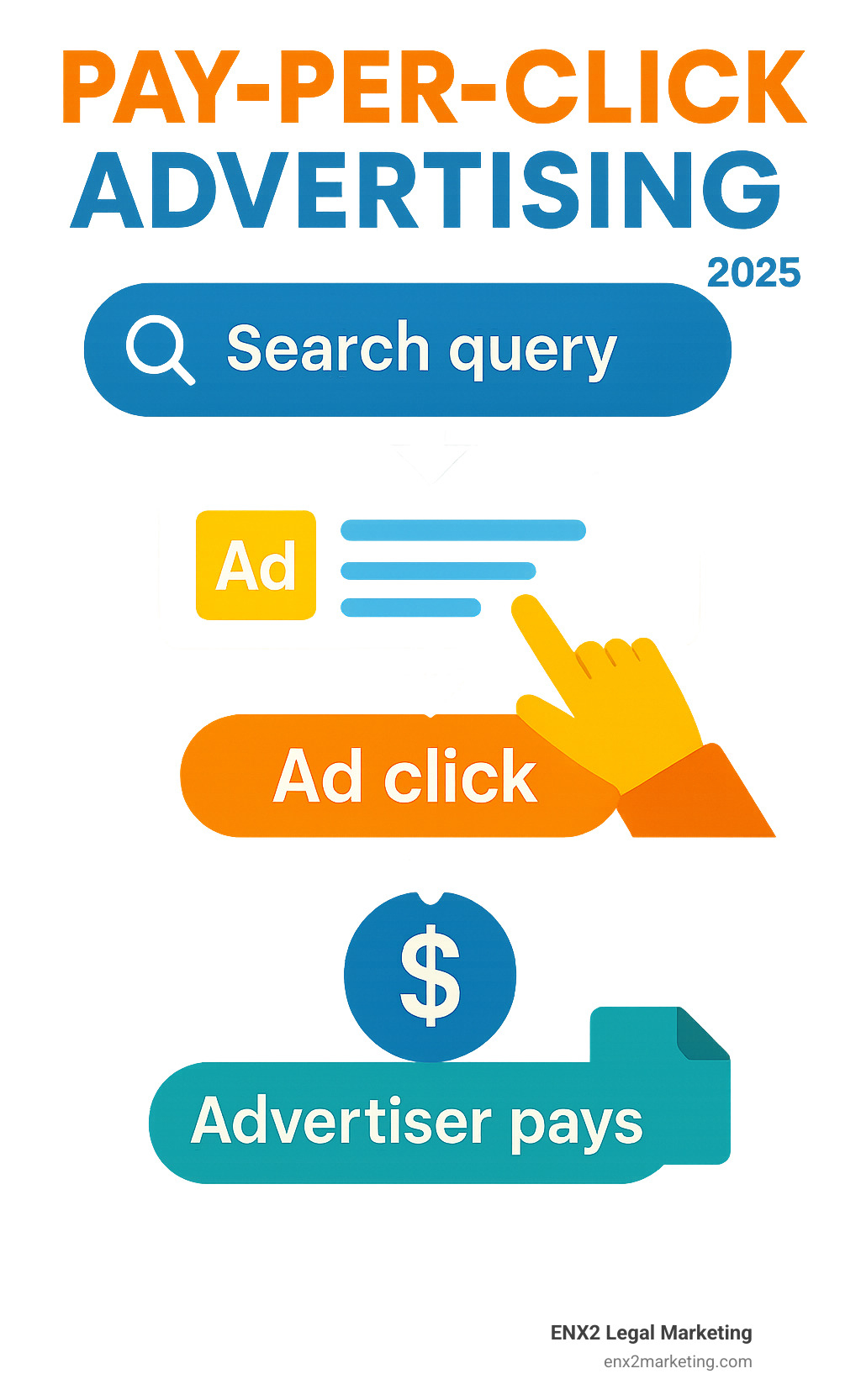
What is Pay-Per-Click Advertising?
Pay-Per-Click (PPC) advertising is an online advertising model where advertisers pay a fee each time one of their ads is clicked. Instead of earning website visits organically through SEO, PPC allows you to buy targeted traffic.
The core principle is simple: you only pay for the interaction (the click), making it a strategic investment also known as Cost-Per-Click (CPC). The primary goal is to ensure the value generated from a click exceeds its cost, leading to a positive return on investment (ROI).
With over a decade of experience in digital marketing, our team at ENX2 Legal Marketing has seen how effective pay per click advertising is for businesses seeking rapid, measurable growth online.
The Ultimate Guide to Pay-Per-Click Advertising
Pay per click advertising is a dominant force in digital marketing, with a vast majority of businesses leveraging it for growth. Understanding its core mechanics is the first step to using its power. This guide breaks down everything you need to know, from how ad auctions work to launching and measuring your own successful campaigns.
How PPC Works: The Ad Auction, Bidding, and Quality Score
The core of pay per click advertising is the “ad auction,” an automated process that determines which ads are shown and in what order. When a user enters a search query, platforms like Google and Bing initiate an auction among advertisers bidding on relevant keywords. This decision is based on two key factors: your bid and your Quality Score.
Bidding and Quality Score
Your maximum bid is the highest amount you’re willing to pay for a click. However, you often pay less—just enough to outrank the competitor below you.
Your Quality Score is a rating from 1 to 10 that measures the quality and relevance of your ads, keywords, and landing pages. It’s influenced by:
- Expected Click-Through Rate (CTR): The likelihood your ad will be clicked.
- Ad Relevance: How well your ad matches the user’s search intent.
- Landing Page Experience: The quality of the page users land on after clicking.
Ad Rank: The Formula for Success
Your Ad Rank, which determines your ad’s position, is calculated by multiplying your bid by your Quality Score.

Ad Rank = Maximum Bid x Quality Score
A high Quality Score can help you achieve a better ad position at a lower cost, even against competitors with higher bids. This system rewards relevance, a concept Google explains in detail in its guide on Ad Rank. While platforms have systems to combat it, advertisers should be aware of the challenge of click fraud, where illegitimate clicks can waste ad spend.
Key Platforms and Ad Formats for Your Campaign
Modern pay per click advertising extends far beyond simple text ads, offering diverse platforms and formats to reach your target audience.
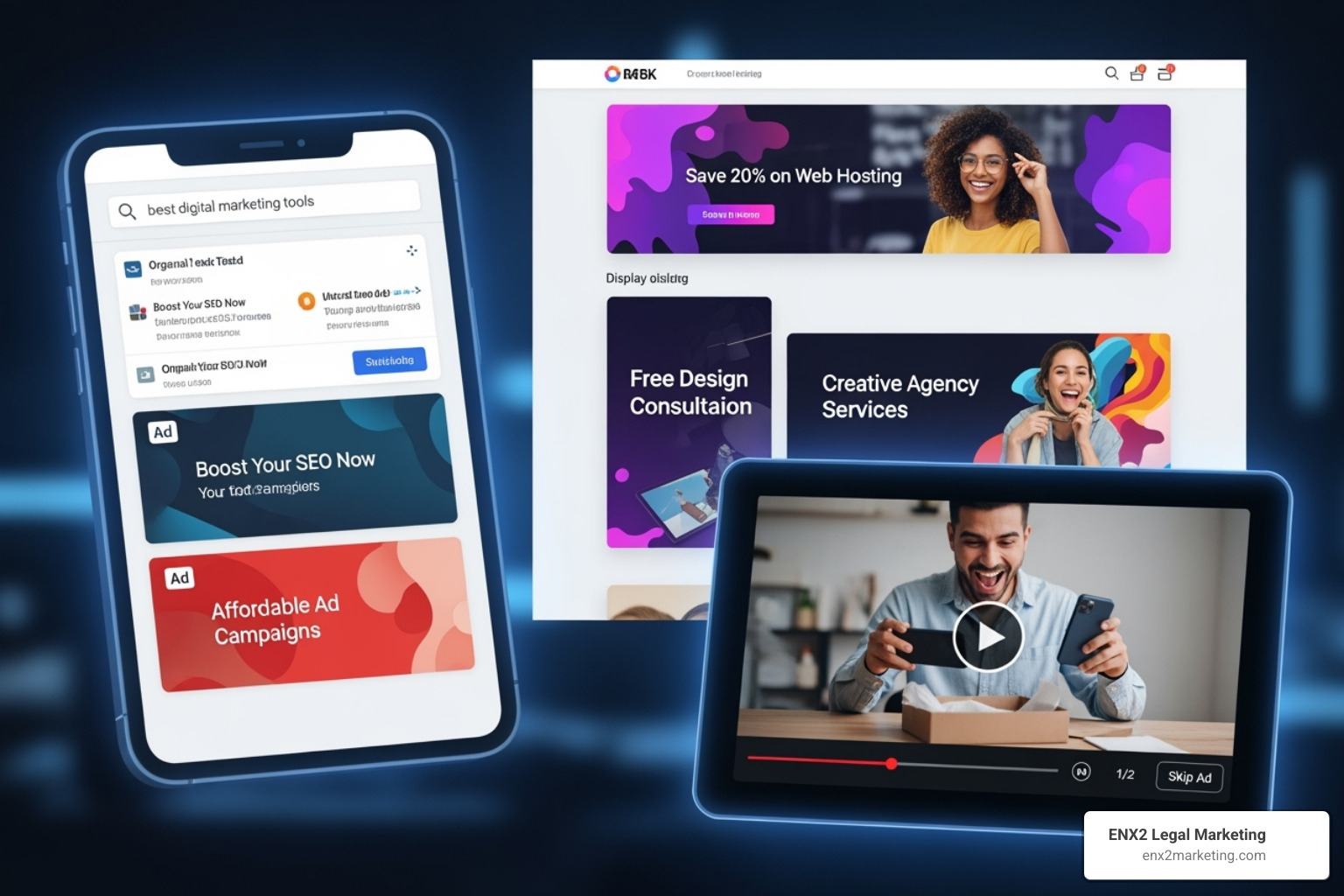
Key Advertising Platforms:
- Google Ads: The largest PPC platform, covering Google Search, YouTube, and a vast network of partner websites (the Display Network).
- Microsoft Advertising: Reaches users on Bing, Yahoo!, AOL, and MSN, often with less competition than Google.
- Social Media Platforms: Includes Meta (Facebook, Instagram), LinkedIn, TikTok, and Twitter, offering powerful demographic and interest-based targeting.
Common Ad Formats:
- Search Ads: Text-based ads that appear on search engine results pages (SERPs), targeting users with active search intent.
- Display Ads: Visual ads (images, banners) shown across a network of websites, ideal for building brand awareness. Learn more about Search Ads vs. Display Ads.
- Video Ads: Engaging video content primarily used on platforms like YouTube and social media feeds.
- Remarketing Ads: Target users who have previously visited your website, reminding them of your brand.
- Shopping Ads: Showcase products with images and pricing directly in search results for e-commerce businesses.
- App Ads: Promote mobile app installations and engagement across various networks.
The Strategic Importance of Pay-Per-Click Advertising for Business Growth
PPC is a cornerstone of modern digital marketing because it delivers tangible, trackable results that fuel business growth.
- Immediate Results: Unlike SEO, which takes time to build, PPC campaigns can generate visibility and traffic almost instantly.
- Measurable Performance and ROI: Every click, conversion, and cost is trackable, allowing for precise ROI calculation. On average, businesses earn $2 in revenue for every $1 spent on Google Ads.
- Granular Targeting and Audience Control: Reach specific customers based on keywords, demographics, location, interests, and online behavior. You have complete control over who sees your ads.
- Budget Control: Set daily or monthly budgets to ensure you never overspend. This flexibility makes PPC accessible for businesses of any size.
- Brand Awareness Boost: Even without a click, appearing in top ad positions increases brand recognition. Paid ads can lift brand awareness by up to 80%.
- Informing SEO Strategy: PPC data on keyword performance, conversion rates, and ad copy effectiveness provides invaluable insights that can directly inform and strengthen your long-term SEO efforts. For example, you can test which keywords drive the most valuable traffic through a PPC campaign before investing months into ranking for them organically. Similarly, high-performing ad copy can inspire meta descriptions and page titles that improve organic click-through rates. The two strategies work best when used together, creating a synergistic loop of data and performance, as explained in Why You Should Use PPC in Addition to SEO.
Planning and Launching Your First Pay-Per-Click Advertising Campaign
A successful pay per click advertising campaign requires strategic planning and execution to maximize your return on investment.

1. Set Clear Goals: Define what success means for your campaign. Are you aiming for website traffic, lead generation, online sales, or brand awareness? Clear goals guide every decision.
2. Establish a Budget: Determine a realistic budget based on your goals and industry CPCs. Control your spending with daily or monthly caps.
3. Conduct Keyword Research: Identify the terms your potential customers use to find your services. Use different keyword match types (Broad, Phrase, and Exact) to control ad visibility. Google provides excellent resources on keywords for Search campaigns.
4. Use Negative Keywords: Prevent your ads from showing for irrelevant searches by creating a list of negative keywords. This saves money and improves targeting.
5. Craft Compelling Ad Copy: Write ads that are relevant, highlight your unique value proposition, and include a clear call-to-action (CTA) like “Call Now” or “Get a Free Quote.”
6. Optimize Landing Pages: Ensure the page users land on after a click is relevant, user-friendly, and designed to convert. A strong landing page is critical for success, which is why we often recommend dedicated PPC Landing Pages for Your Law Firm.
Essential Metrics for Measuring PPC Success
In pay per click advertising, data is everything. Tracking key metrics is essential for optimizing campaigns and proving ROI.
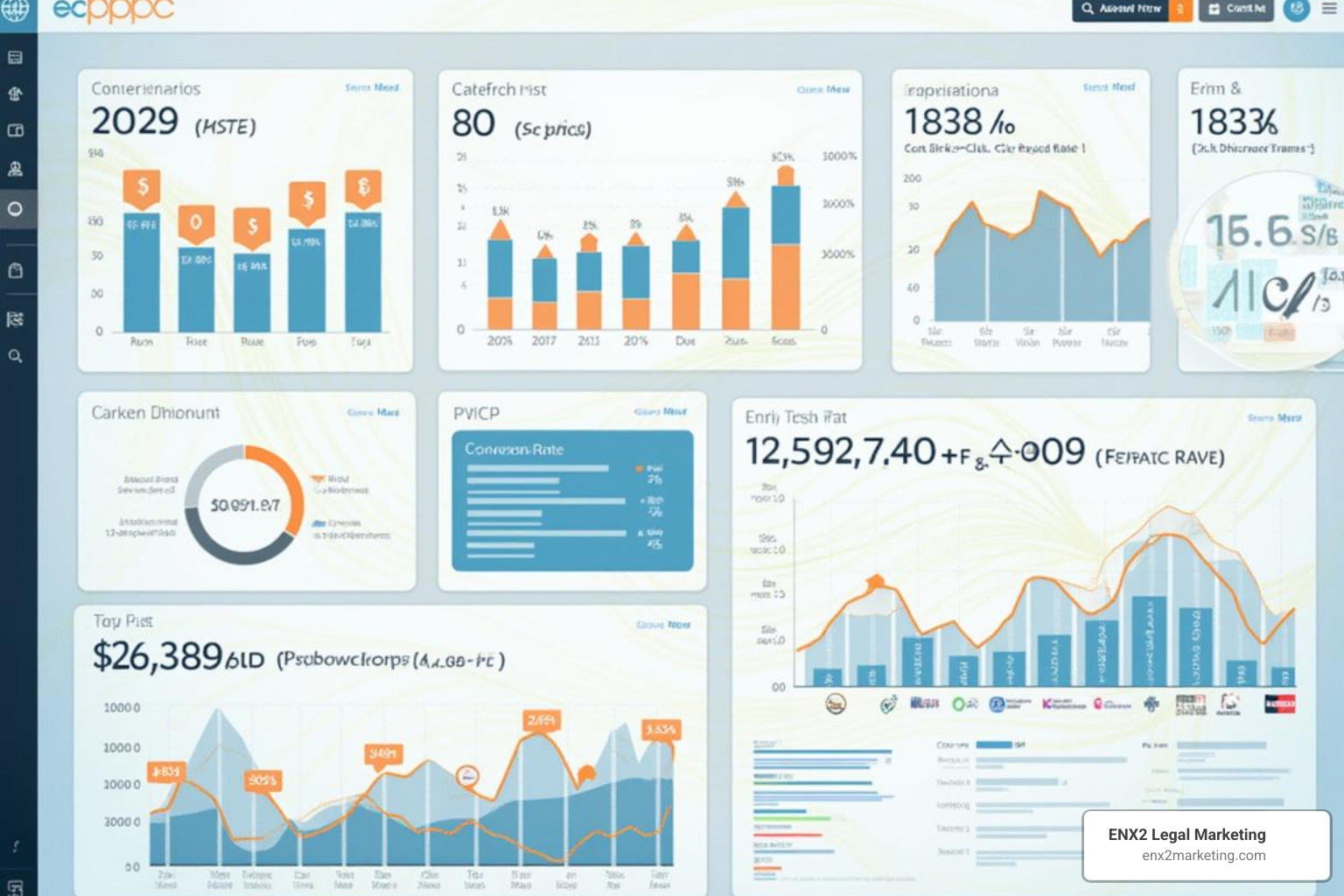
Here are the core metrics to monitor:
- Impressions: The number of times your ad is shown.
- Click-Through Rate (CTR): The percentage of impressions that result in a click.
- Cost-Per-Click (CPC): The average cost you pay for each click.
- Conversion Rate (CR): The percentage of clicks that result in a desired action (e.g., a form fill or sale).
- Cost Per Acquisition (CPA): The total cost to acquire one new customer or lead.
- Return On Ad Spend (ROAS): The total revenue generated for every dollar spent on advertising.
- Quality Score (QS): The 1-10 rating in Google Ads that measures ad, keyword, and landing page relevance.
Understanding How Can You Track Your Paid Ads? is fundamental to making data-driven decisions that improve performance.
Understanding the Difference: PPC vs. SEO vs. SEM
The digital marketing world is full of acronyms. It’s crucial to understand how PPC fits with Search Engine Optimization (SEO) and Search Engine Marketing (SEM).
- Search Engine Marketing (SEM): This is the umbrella term for all activities designed to increase search engine visibility, including both paid and organic strategies.
- Search Engine Optimization (SEO): This is the practice of optimizing your website to rank higher in the organic (non-paid) search results. It’s a long-term strategy for building authority and sustainable traffic.
- Pay-Per-Click (PPC): This is the paid component of SEM, where you buy traffic by bidding on keywords. It delivers immediate results.
Here’s a quick comparison:
| Feature | Pay-Per-Click (PPC) | Search Engine Optimization (SEO) |
|---|---|---|
| Cost | Pay per click | Clicks are free, but you invest time/resources |
| Speed of Results | Immediate | Slower (can take weeks to months) |
| Placement | Paid ad sections (top/bottom of SERPs) | Organic, natural search results |
| Longevity | Stops when your budget runs out | Lasts as long as your ranking holds |
While different, PPC and SEO are most powerful when combined. Learn more about Blending a Strategic SEO & PPC Strategy for Great Results.
Partnering for PPC Success
As we’ve explored, pay per click advertising is a powerful tool for business growth, offering immediate, measurable results with unparalleled targeting and budget control. It’s a direct path to connecting with clients actively seeking your services.
However, managing a successful PPC campaign is a complex, full-time job that requires constant monitoring, optimization, and deep expertise. For busy law firms, dedicating the necessary resources is often impossible while focusing on client cases.
This is where ENX2 Legal Marketing excels. Celebrating 10 years in business, we are a law firm marketing agency that has mastered the art and science of PPC. We let you focus on practicing law while we handle the complexities of digital advertising. Our approach is built on data-driven strategies and specialized law firm data and analytics consulting. We use these insights to build campaigns that reach the right clients and deliver measurable results.
From developing high-converting landing pages through custom web design to implementing call tracking metrics for precise ROI analysis, we build a comprehensive PPC ecosystem designed to drive qualified leads to your firm. With offices in Pennsylvania and Los Angeles, we partner with elite law firms across the nation to maximize their return on investment and showcase their practice in innovative ways.
If you’re ready to open up the full potential of pay per click advertising for your law firm, we’re here to build a strategy custom to your goals.
Explore our PPC Management for Law Firms services to begin your journey toward digital marketing success.