Why Your Legal Website Content Can Make or Break Your Practice
Legal website content is the foundation of your firm’s online presence. It’s often the deciding factor for a potential client choosing you over a competitor. Your website is their first impression, and they arrive with high stakes, searching for clarity, authority, and reassurance. Effective content builds the trust necessary to convert a visitor into a client by speaking directly to their concerns and demonstrating your expertise.
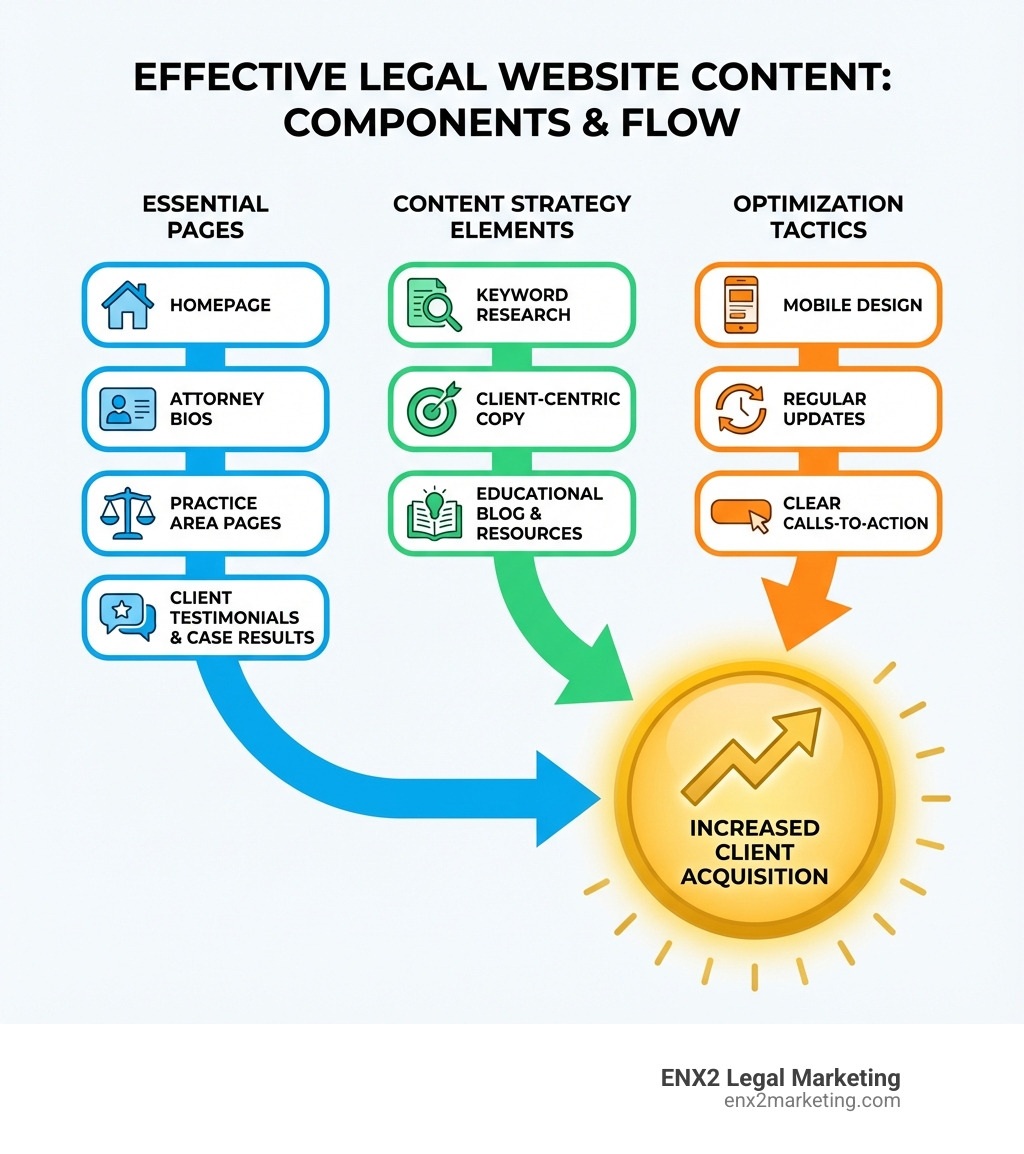
Key components include:
- Homepage: Your digital front door, communicating who you are and why clients should trust you.
- Practice Area Pages: Detailed explanations of your services that demonstrate expertise.
- Attorney Bios: Personal introductions that build connection and showcase experience.
- Testimonials & Case Results: Social proof that establishes credibility.
- Blog & Educational Content: Resources that position you as an authority.
- Calls-to-Action: Prompts that guide visitors toward a consultation.
Quality content also determines if clients can find you online. Search engines prioritize websites with relevant, well-structured content that answers user questions. Without it, your firm remains invisible. I’m Nicole Farber, and over the past 12 years building ENX2 Legal Marketing, I’ve helped countless law firms transform their digital presence. This guide shares the blueprint we use to create legal website content that ranks well, builds trust, and converts visitors into clients.
The Blueprint for High-Performing Legal Website Content
Successful legal website content follows a strategic process to attract, engage, and convert potential clients. This is the core of a robust digital marketing strategy for any law firm.
Step 1: Laying the Foundation with Essential Pages
Every law firm website needs a foundation of essential pages that guide potential clients, build trust, and showcase expertise.
- Homepage: Your firm’s digital front door. It must make an immediate impact by clearly communicating who you are, what you do, and why a client should choose you.
- About Us Page: This page gives your firm personality and purpose, sharing your mission and values to build a connection with potential clients.
- Practice Area Pages: These are crucial for conversion. Each page should detail a specific legal service, explain the matters you handle, and demonstrate your expertise.
- Attorney Bios: Often the most visited pages, bios build a personal connection. We focus on experience, compassion, and approachability to humanize your firm.

- Testimonials & Case Results: This is powerful social proof. Testimonials from satisfied clients and concrete case results build instant credibility and influence a potential client’s decision.
- Blog & FAQs: An educational hub to showcase expertise and answer common client questions. Regularly updated, valuable content also improves search engine rankings.
- Contact Page: This page must be simple and provide all necessary contact information, including a form, to make it easy for clients to take the next step.
- Location Pages: For firms with multiple offices in places like Washington DC, New York, or Pennsylvania, these pages boost local SEO and provide location-specific information.
Step 2: Mastering Compelling Legal Website Content That Converts
With the foundation in place, the focus shifts to crafting content that converts. This requires persuasive, client-centric writing that complies with all ethical standards.
Your copy must speak directly to client pain points. Legal clients are often overwhelmed; your content should ease their worries by answering their questions clearly. Avoid jargon and write in plain English, aiming for an 8th-grade reading level. Since most visitors skim, structure content with clear headlines, short paragraphs, and bullet points for scannability.
Building trust is paramount. All content must be accurate and comply with bar advertising rules regarding case results, testimonials, and claims. We verify all information and never guarantee outcomes. Proofreading is non-negotiable, as typos can undercut your credibility.
Finally, strategically placed calls-to-action (CTAs) are crucial for converting visitors into leads. Use clear, action-oriented phrases like “Schedule Your Consultation” to guide users. Trust-building elements are key, leveraging a psychological principle known as social proof, where people are influenced by the actions and experiences of others.
Step 3: Driving Growth with SEO and Strategic Content Ideas
Effective legal website content must be findable. This is where search engine optimization (SEO) and strategic content ideas come into play.
To appear in search results, your content must include the keywords people are using. We begin with thorough keyword research to understand user intent and optimize content accordingly. Learn more about keyword research in this guide from Google. Analyzing competitor content also helps identify gaps and opportunities to create superior, more engaging material.
We tailor content for different stages of the client journey:
- Awareness: Educate potential clients who are just realizing they have a legal problem. This includes blog posts, how-to guides, and infographics.
- Consideration: Build trust with clients who are researching solutions. This includes in-depth guides and detailed FAQs.
- Decision: Convert clients who are ready to choose a firm. Case studies, detailed testimonials, and comparison pages are highly effective here.
Visuals like images and infographics are also vital. They make complex legal information more digestible and can highlight your firm’s successes, further establishing credibility.
Optimizing and Managing Your Content for Long-Term Success
Creating compelling legal website content is an ongoing process. To ensure your strategy remains effective, we focus on continuous optimization, technical improvements, and strategic management.
Enhancing Content with Smart Design and User Experience
The best content can fail if the website design is poor. A positive user experience (UX) is critical for keeping visitors engaged.

Here are our best practices for enhancing content through design:
- Mobile-First Design: With most traffic coming from mobile, a responsive design that adapts to any screen size is essential for readability and navigation.
- Site Navigation: We structure navigation so visitors can find information within two clicks, minimizing frustration and reducing bounce rates.
- Scannability: We use clear headings, subheadings, and bullet points to make content digestible at a glance for visitors who skim.
- Page Speed: Slow-loading sites lose visitors. We optimize images and code to ensure fast load times, as first impressions are made in milliseconds.
- Website Security: A secure website (HTTPS) builds trust with visitors and is favored by search engines.
- Consistent Branding: A consistent visual identity across your site reinforces your professional image and builds brand recognition.
The Future of Your Legal Website Content: AI, Updates, and Outsourcing
Your legal website content strategy must evolve with the digital landscape. This means embracing regular updates, understanding AI, and knowing when to outsource.
Content requires regular maintenance. We recommend reviewing and refreshing pages quarterly to ensure information is accurate and trustworthy, as both search engines and clients favor fresh content. A stagnant website can hurt your credibility and search rankings.
While attorneys are skilled writers, their time is better spent on billable work. Outsourcing content creation to marketing specialists is often more cost-effective and ensures a consistent stream of high-quality, SEO-optimized content without straining your firm’s resources.
AI is changing content creation and optimization. It requires a greater focus on technical SEO and well-structured, authoritative content. For law firms, this means aligning with Google’s E-E-A-T (Experience, Expertise, Authoritativeness, Trustworthiness) framework, which is crucial for “Your Money or Your Life” (YMYL) topics. AI can assist with research, but human oversight is essential for accuracy, ethical compliance, and capturing your firm’s unique voice.
Measuring What Matters: Analytics and Continuous Improvement
Measuring success and making data-driven improvements is what drives growth. We monitor key performance indicators (KPIs) to gauge content effectiveness:
- Website Traffic: Understanding how visitors find your site (organic, paid, social, etc.).
- Engagement Metrics: Time on page and bounce rate show how well content resonates.
- Conversion Rates: Tracking form submissions and calls measures how effectively content turns visitors into leads.
- Content ROI: Assessing the return on investment by comparing content costs to revenue generated.
Your content goals must align with your overall business objectives. A content audit can determine if your existing content is meeting those needs. The tone and focus of your content will also vary by practice area—from empathetic for family law to assertive for criminal defense. Our team at ENX2 Marketing understands these nuances.
At ENX2 Legal Marketing, we help law firms in Washington DC, New York, California, and beyond leverage strategic legal website content. From custom web design to comprehensive content marketing, we provide the expertise to ensure your firm stands out. Explore our custom web design services and let us help you build an engaging, converting online presence.