Why PPC is a Non-Negotiable for Modern Law Firms
Legal pay per click (PPC) advertising is the fastest way for law firms to get in front of high-intent clients. These are ads that appear at the top of search results, and you only pay when someone clicks. This strategy offers immediate visibility, precise targeting of active searchers, measurable ROI, and full budget control.
While costs vary by practice area—personal injury keywords can range from $150-$300 per click—the investment is often necessary. Over 75% of people start their search for an attorney online, and the top paid ad on Google often gets more clicks than the #1 organic result. If you’re not using PPC, your competitors are capturing your potential clients while you wait for SEO to deliver.
I’m Nicole Farber, and over the past 12 years building ENX2 Legal Marketing, I’ve seen how PPC campaigns can transform law firms. My expertise in legal digital marketing has helped countless attorneys achieve the online visibility and client acquisition needed for growth.
A Lawyer’s Playbook for High-ROI Legal Pay Per Click
While SEO builds your reputation over time, legal pay per click advertising puts you in front of potential clients today. However, a successful campaign requires a strategic playbook.
Step 1: Architecting Your Campaign Strategy
A successful legal pay per click campaign starts with understanding that potential clients search for solutions to urgent problems, not legal theories.
Finding the Right Keywords
Focus on high-intent keywords that signal an immediate need, such as “car accident lawyer near me” or “divorce attorney Chicago.” These fall into several categories:
- Service-specific: “DUI lawyer”
- Location-based: “personal injury lawyer Chicago”
- Problem-focused: “wrongful termination help”
Equally important are negative keywords—terms you don’t want to pay for. Excluding words like “jobs,” “school,” or “free advice” prevents wasted ad spend on irrelevant searches.
Creating Ads That Actually Work
Your ad copy must be a concise elevator pitch. Be crystal clear about the problem you solve (e.g., “Injured in a Car Accident? Get Compensation”) and highlight your unique value (“Free Consultation,” “No Win, No Fee”). Use ad extensions to boost click-through rates:
- Call extensions for direct mobile calls.
- Sitelink extensions to guide users to specific pages like “Practice Areas.”
- Location extensions to help local clients find your office.
Choosing Your Battlefield
While Google Ads is dominant, don’t ignore other platforms. Microsoft Ads often has a lower cost-per-click and reaches an older demographic. Social media platforms like Facebook are excellent for building trust in practice areas like family law. The key is to match the platform to your goal: Google for active searchers, and social media for building relationships.
Our PPC Management for Law Firms service handles these complexities so you can focus on your clients.
Step 2: Managing Budgets for Your Legal Pay Per Click Campaign
Legal keywords are among the most expensive. Personal injury terms can cost $150-$300 per click, while DUI keywords can run $80-$160. These high costs reflect the high value of a potential case. A single client can generate tens of thousands in fees, justifying the initial ad spend.

Smart Budgeting Strategies
- Starting Budget: Most small to mid-sized firms should budget $1,500 to $5,000 monthly for PPC to gather enough data for optimization.
- Bidding: Use automated bidding strategies like “Maximize Conversions” to let Google’s AI optimize bids in real-time.
- Focus on ROI: The goal isn’t the lowest cost-per-click, but the highest return on investment. A $100 click that consistently leads to a $10,000 case is a win. Track conversions from click to signed case to understand your true ROI. Some keywords cost more per click than other words because of their high conversion value.
Step 3: Maximizing Conversions with Landing Pages and Tracking
Getting the click is only half the battle. The post-click experience determines whether a lead converts or leaves.
Landing Pages That Convert
Never send ad traffic to your generic homepage. Use dedicated landing pages that match the ad’s promise. A “car accident lawyer” ad should lead to a page exclusively about car accident cases. Effective landing pages are:
- Focused: No distracting links to other practice areas.
- Mobile-Friendly: Over 60% of legal searches are on mobile.
- Fast-Loading: A one-second delay can reduce conversions by 7%.
- Trust-Building: Feature client testimonials, credentials, and clear contact information.
Keep contact forms simple: name, phone, email, and a brief message field are usually enough. For more on this, see our guide: Do You Need PPC Landing Pages for Your Law Firm?
Tracking What Matters
Success in legal PPC requires obsessive tracking to know which ads and keywords generate clients.
- Call Tracking: Use unique phone numbers to attribute calls to specific campaigns.
- Form Tracking: Monitor every form submission back to its source.
- Offline Conversion Tracking: Connect ad data to your client intake process to see which clicks become paying clients. This is the key to calculating true ROI.
Google Analytics is the foundation, but a specialized setup is needed to capture the full client journey.
Step 4: Avoiding Common Mistakes in Legal Pay Per Click Advertising
Even experienced firms can make costly PPC errors. Here are the most common pitfalls to avoid:
- Sending Traffic to a Homepage: This is the #1 mistake. Always use dedicated landing pages relevant to the ad.
- Ignoring Mobile Users: Most legal searchers are on their phones. A poor mobile experience means lost leads.
- Neglecting Ad Scheduling: Don’t run ads 24/7 if you can’t respond. Schedule ads for times when your team is available to handle inquiries.
- Poor Geographic Targeting: Ensure your ads only show to users in the locations you actually serve.
- Forgetting Quality Score: Google rewards relevant ads and landing pages with a higher Quality Score, which leads to lower costs and better ad positions.
- Violating Bar Association Rules: All ad copy must be compliant. Avoid guaranteeing outcomes or making misleading claims to build trust and avoid disciplinary action.
For more insights, read our guide: How Can You Track Your Paid Ads?
Step 5: Integrating Advanced Tactics like LSAs and AI
Take your PPC strategy to the next level with advanced tools.
Local Service Ads (LSAs)
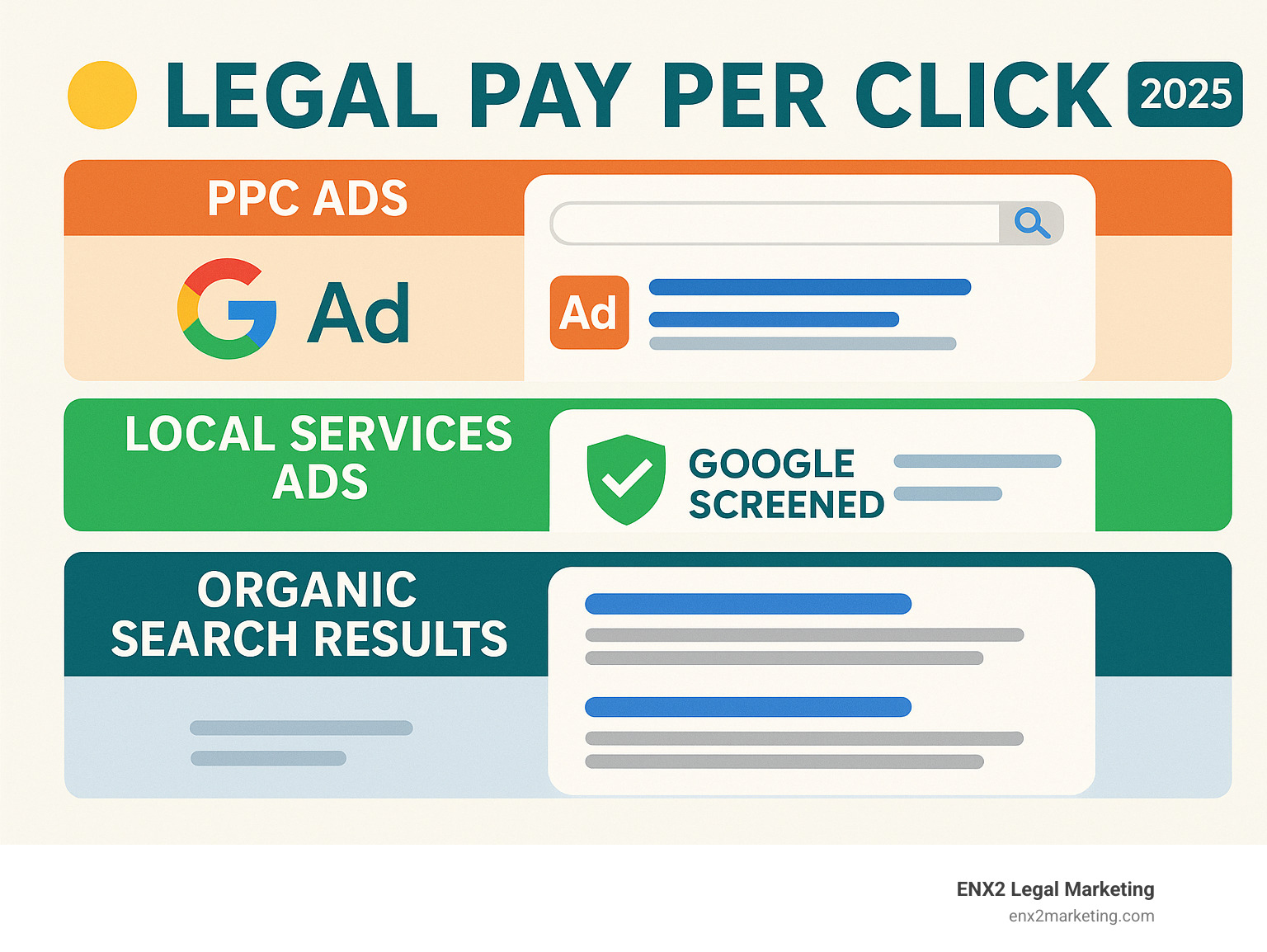
Appearing above traditional PPC ads, Local Service Ads are a pay-per-lead model, meaning you only pay for a direct contact, not a click. The “Google Screened” badge that comes with LSAs acts as a powerful trust signal, verifying your firm’s credentials and boosting conversion rates.

PPC and LSAs: Better Together
The smartest firms use both. LSAs capture high-intent local leads with maximum trust, while traditional PPC allows for granular control over messaging for specific practice areas. Together, they allow you to dominate the top of the search results page. Learn more about how paid and organic search work together in our guide to SEO vs SEM.
AI in PPC
Artificial intelligence is supercharging campaign management. Tools like automated bidding and Performance Max campaigns use AI to analyze thousands of signals and optimize your ads across Google’s entire network (Search, YouTube, Display, etc.). This allows for greater efficiency and lets your marketing partner focus on high-level strategy.
Conclusion: The Final Verdict on PPC for Your Firm
The verdict is in: legal pay per click advertising is an essential tool for connecting your firm with clients at the exact moment they need legal help. It provides immediate visibility, measurable results, and a direct line to high-intent individuals actively searching for your services.
Success requires a strategic approach, from targeting the right keywords and creating compelling ads to building high-converting landing pages and tracking true ROI. By avoiding common mistakes and integrating advanced tactics like Local Service Ads and AI, you can build a campaign that outsmarts, not just outspends, the competition.
Continuous optimization is critical, as the digital landscape is always changing. This is where expertise makes the difference. At ENX2 Legal Marketing, we have spent over a decade perfecting digital marketing for law firms across the nation. We understand the nuances of the legal industry and how to translate marketing spend into signed cases.
Your competitors are already using PPC to capture clients. Every day you wait is a missed opportunity. An investment in a professionally managed legal pay per click campaign provides more than just leads; it delivers invaluable market data and builds a foundation for sustainable growth.
Ready to stop watching competitors win your ideal clients? Contact our SEO agency for lawyers to build a comprehensive digital strategy that puts your firm at the top of the search results. Let’s build a PPC campaign that delivers justice for your bottom line.