

Unlock Growth: A Lawyer’s Guide to Google Ads
Why Google Ads Are Essential for Law Firms
Google Ads for attorneys is a pay-per-click (PPC) advertising platform that places your law firm at the top of Google search results when potential clients are actively looking for legal help. Here’s what you need to know:
- Immediate Visibility: Your ads appear instantly at the top of search results, above organic listings.
- High-Intent Traffic: Connect with people actively searching for legal services right now.
- Pay Only for Results: You’re charged only when someone clicks your ad.
- Precise Targeting: Reach clients by location, practice area, and specific legal needs.
- Measurable ROI: Track every dollar spent and every case signed.
When someone searches “car accident lawyer near me” or “divorce attorney,” they are not browsing. They are usually ready to hire. Industry research shows that a large share of people seeking legal help now start their journey online, making search a critical battleground for client acquisition. According to the American Bar Association, online search is one of the primary ways consumers find and compare law firms.
The challenge? The legal field is one of the most competitive and expensive advertising landscapes. A study of Google Ads keywords found that legal terms dominate the list of the priciest search terms, with a single click often costing a significant amount.
That is where strategy matters. Throwing money at Google Ads without a plan is a fast way to burn through your budget with few or no cases to show for it. But when done right—with smart keyword targeting, optimized landing pages, ethical ad copy, and proper tracking—Google Ads becomes one of the fastest, most reliable ways to generate qualified leads.
I am Nicole Farber, founder of ENX2 Legal Marketing. For over 12 years, my team and I have helped law firms steer the complexities of Google Ads for attorneys to generate consistent, high-value cases while staying compliant with legal advertising guidelines in jurisdictions across the United States.
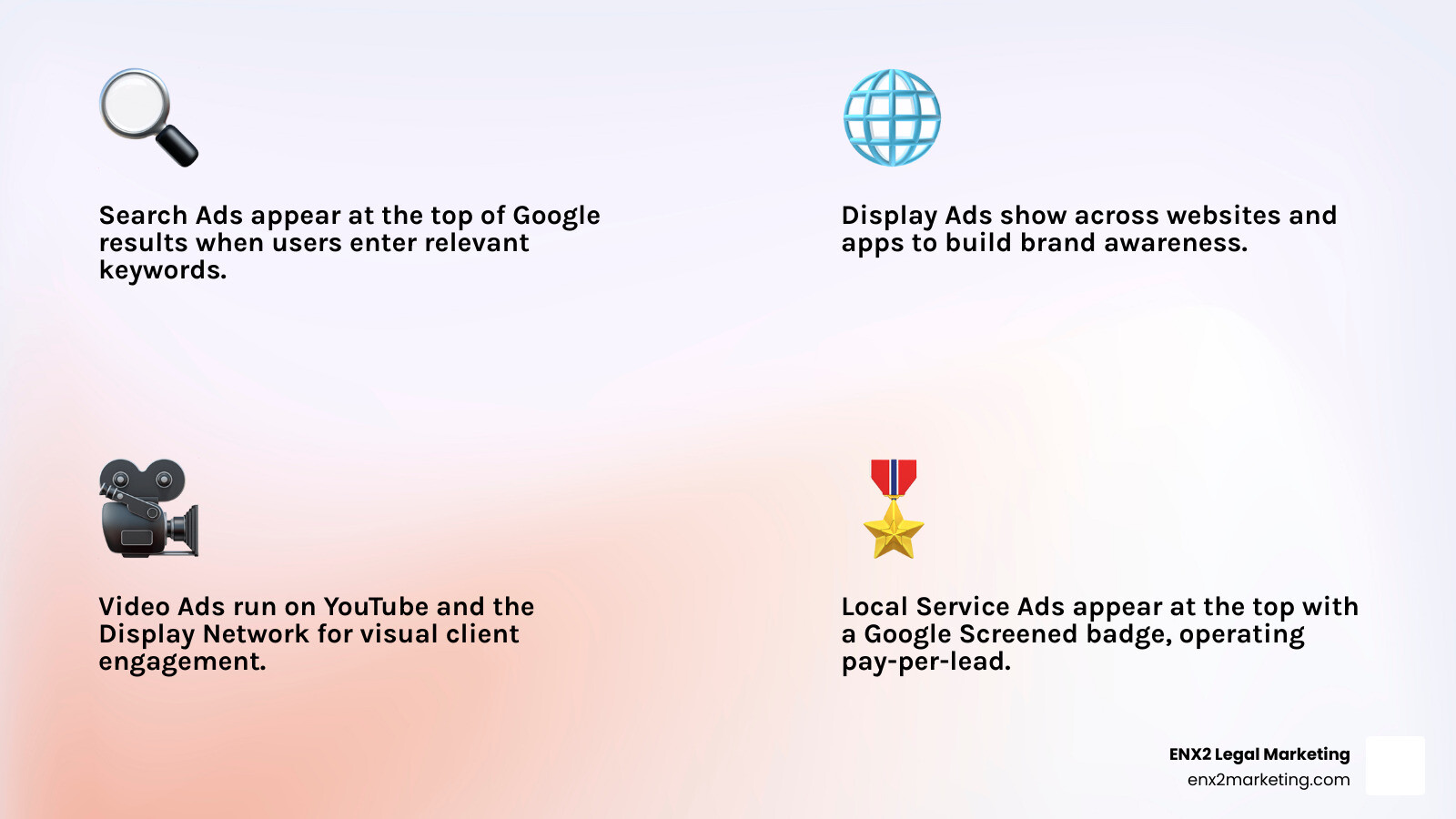
Setting Up Your First Campaign: A Step-by-Step Guide to Google Ads for Attorneys
Launching your first Google Ads campaign can feel complex, but a clear roadmap can set a strong foundation for success. This guide provides an overview of the essential steps for law firms that want ethical, data-driven growth.
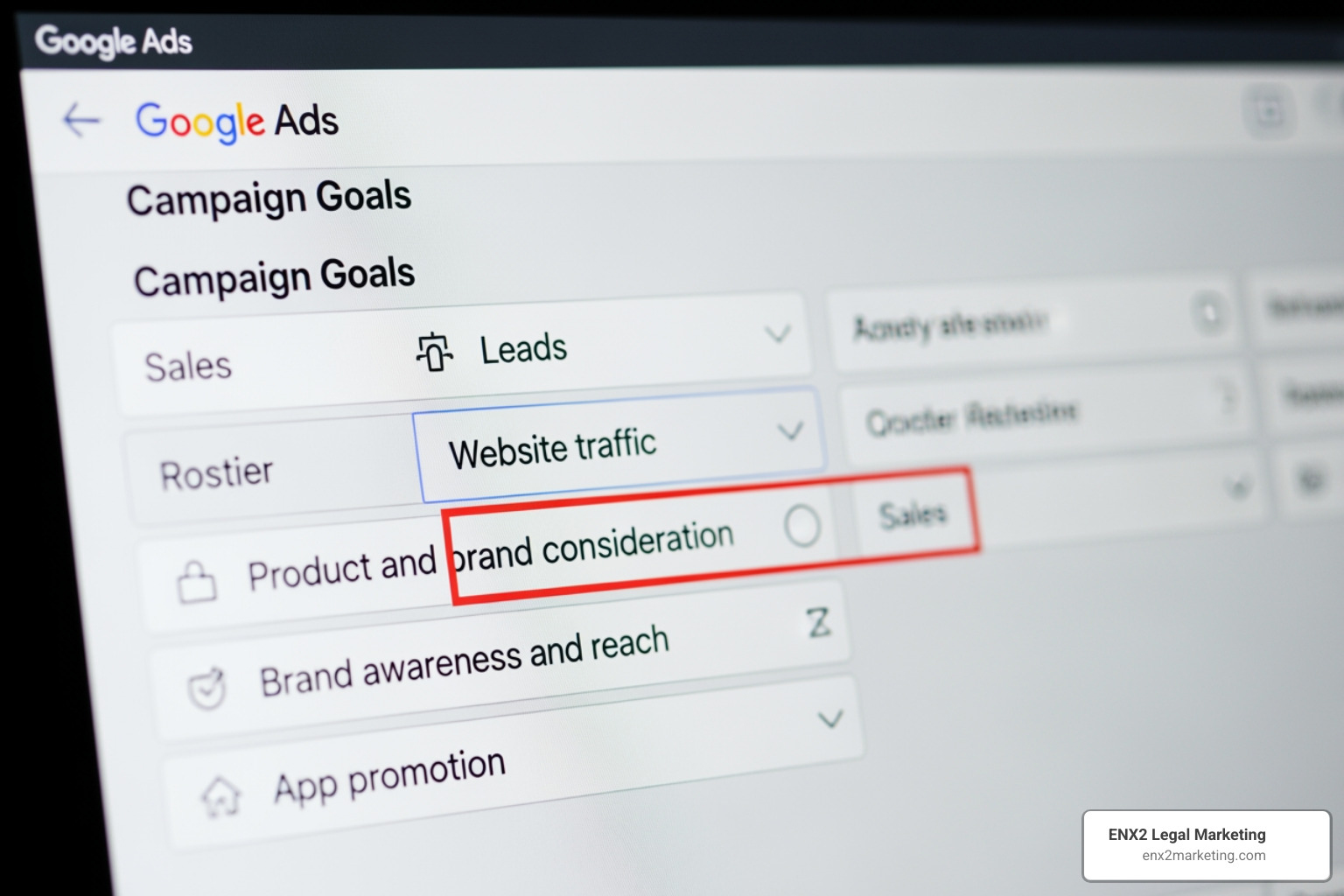
1. Laying the Foundation: Goals, Audience, and Budget
First, set up your account at ads.google.com. The initial prompts are straightforward, but your strategy begins when you define your goals. For most law firms, the primary objective is generating leads (qualified calls and form submissions), though some practices may also prioritize brand visibility.
Next, identify your target audience with precision to avoid wasted ad spend.
- Geographic Targeting: Since law is often local and jurisdiction-specific, this is paramount. Use geo targeting to show ads to people “present” in a specific location, like within 20 miles of your Wilkes-Barre office or across a state where you are licensed.
- Language Targeting: If you serve a specific linguistic community, language targeting ensures your ads reach the right users, such as a Spanish-speaking audience in California.
- Demographic and Audience Signals: Where allowed, you can layer in age ranges, household income brackets, or in-market audiences to refine who sees your ads, while respecting privacy and platform policies.
Finally, set a realistic budget. The legal industry has a notoriously high Cost-Per-Click (CPC). While a significant monthly investment is required, the potential return is substantial, as even a small percentage of conversions can lead to high-value cases. Your budget should reflect your practice area, location, and desired lead volume, as well as your average case value and client lifetime value.
2. The Core of Your Campaign: Keywords
Keywords are the bridge between a potential client’s search and your ad. Proper research ensures you attract high-intent prospects while filtering out unqualified traffic.
- Focus on Long-Tail Keywords: Avoid broad, expensive terms like “lawyer.” Instead, target specific, multi-word phrases like “car accident lawyer Philadelphia” or “wrongful termination attorney in New York.” These have lower search volume but much higher intent, leading to better conversion rates.
- Use Google Keyword Planner: This free tool from Google helps you find keyword ideas, see search volumes, and estimate costs.
- Filter with Negative Keywords: Just as important as choosing what to bid on is choosing what not to. Negative keywords prevent you from paying for clicks from users seeking unpaid advice, job seekers, or law students.
- Understand Match Types: Keyword match types control how closely a user’s search must match your keyword. Phrase and Exact match offer more precision, which is crucial in a high-CPC environment.
| Match Type | Description | Example Keyword | Search Queries That Trigger Ad |
|---|---|---|---|
| Broad Match | Ad may show for searches related to your keyword. | personal injury lawyer |
car accident attorney, injury attorney |
| Phrase Match | Ad may show for searches that include the meaning of your keyword. | "personal injury lawyer" |
best personal injury lawyer, hire personal injury lawyer near me |
| Exact Match | Ad may show for searches with the same meaning as your keyword. | [personal injury lawyer] |
personal injury lawyer, lawyer personal injury |
3. Crafting Compelling Ads That Convert
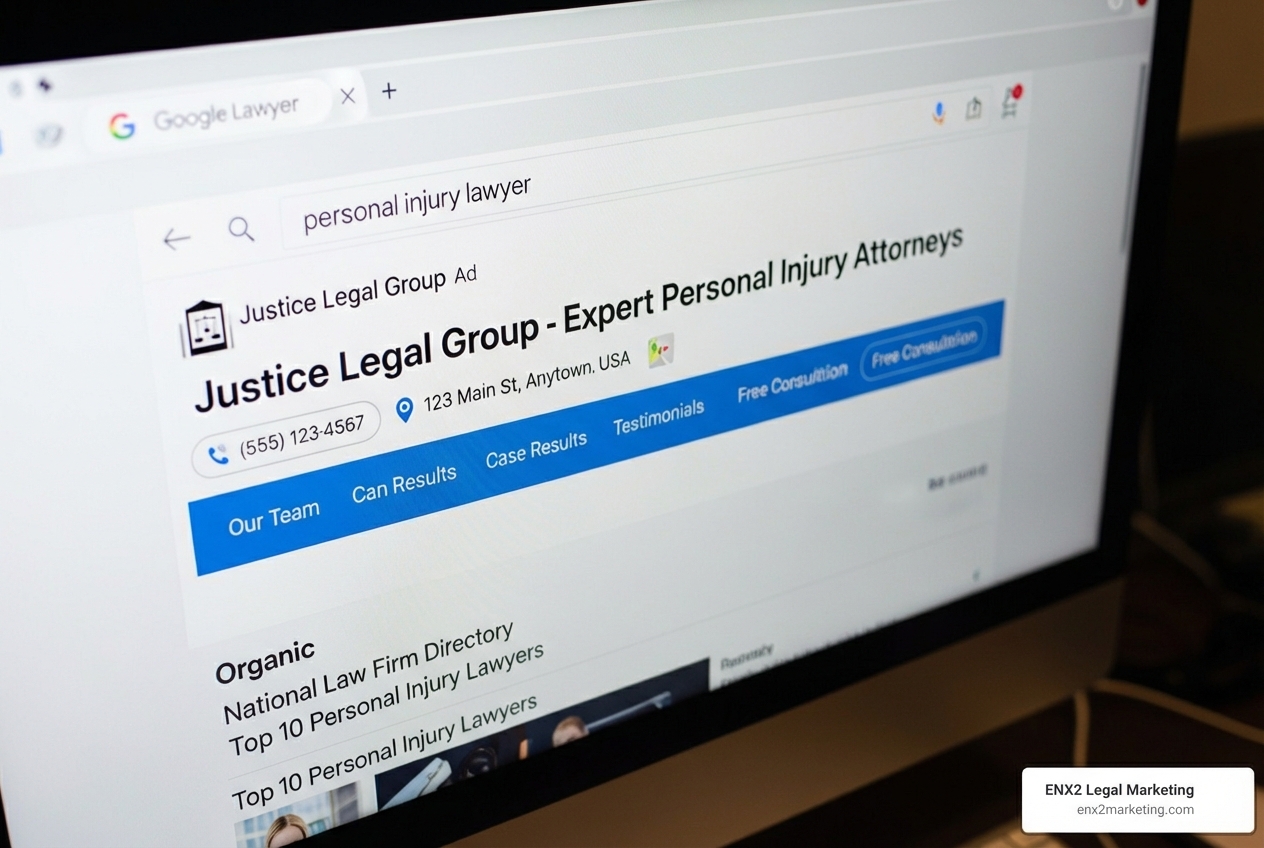
Your ad copy must be clear, concise, and compelling, while aligning with your jurisdiction’s rules on lawyer advertising. Highlight your unique selling propositions (e.g., “Decades of Trial Experience,” “Employment Law Focus,” or “Offices in New York, Pennsylvania, and California”), include a strong call-to-action (e.g., “Call Now for a Confidential Consultation”), and build trust.
Use ad extensions to make your ads larger and more informative:
- Call Extensions: Display your phone number directly in the ad for one-tap calling on mobile.
- Location Extensions: Show your address and a map link, which is vital for local searches. This can integrate with your Google Business Profile.
- Sitelink Extensions: Add links to specific pages like “Case Results,” “Attorney Bios,” or “Practice Areas.”
- Structured Snippets: Highlight specific services (for example, “Practice Areas: Employment Law, Personal Injury, Business Litigation”).
4. Beyond the Click: Landing Page Optimization
A potential client clicked your ad—but the journey is not over. Your landing page must be a seamless continuation of your ad’s promise and compliant with applicable bar advertising rules. A page optimized for conversion includes:
- Relevant Messaging: The content must directly match the ad’s offer. If your ad is about “Los Angeles wrongful termination lawyers,” your landing page should clearly address wrongful termination in Los Angeles or California.
- Prominent Contact Info: Use easy-to-find contact forms and click-to-call buttons. Limit distractions so visitors have a clear path to contact you.
- Mobile Optimization: With a majority of legal searches happening on mobile, your page must function perfectly on all devices. Tools like PageSpeed Insights can help you diagnose performance issues.
- Fast Load Speed: A slow page will lose you leads. Even a few extra seconds can dramatically increase bounce rates.
- Trust Signals: Include client testimonials, case results, professional memberships, and attorney bios to build credibility, while following your jurisdiction’s ethics guidelines on testimonials and past results.
Putting in this groundwork before you ever launch a campaign makes every advertising dollar work harder, especially in competitive markets like Washington, DC, New York, California, Tennessee, and throughout Pennsylvania.
Advanced Strategies and Measuring Success
Setting up your campaign is just the beginning. The real value of Google Ads for attorneys comes from continuous monitoring, measurement, and optimization to maximize your return on investment (ROI) while staying compliant and aligned with your firm’s broader business goals.
Measuring Success and Optimizing Your Campaigns
A data-driven approach is non-negotiable. If you cannot measure it, you cannot improve it. Focus on these Key Performance Indicators (KPIs) to gauge campaign effectiveness:
- Click-Through Rate (CTR): The percentage of people who see your ad and click it. High CTR indicates relevant ad copy and targeting.
- Conversion Rate: The percentage of clicks that result in a lead (a qualified call or form submission). For law firms, this is your most important metric.
- Cost Per Lead (CPL): How much you pay, on average, for each qualified lead.
- Return on Ad Spend (ROAS): The revenue generated for every dollar spent on advertising. For example, if you spend $5,000 in a month and sign $25,000 in new matters that originated from the campaign, your ROAS is 5:1.
To improve these metrics, you must continuously optimize. Run A/B tests on ad headlines and descriptions to see what resonates with potential clients. Always work to improve your Quality Score—Google’s rating of your ad, keyword, and landing page relevance—as a higher score can lead to lower costs and better ad positions. Resources such as Think with Google can provide additional insights into consumer behavior and search trends.
Campaigns are never “set it and forget it.” We recommend weekly reviews to analyze search terms, adjust bids on high-performing keywords, refine your negative keyword list, and optimize your ad schedule to show ads when clients are most likely to convert. Monthly or quarterly reviews should connect advertising data with signed cases and revenue, so you know which campaigns truly drive growth.
Common Mistakes and When to Hire an Expert
Even with a solid strategy, the complexities of Google Ads for law firms present unique pitfalls. Avoiding these common mistakes is critical:
- Neglecting Negative Keywords: This is a huge budget drain. Without them, you will pay for irrelevant clicks from searches like “lawyer jobs” or “free legal advice.”
- Poor Landing Pages: Sending traffic to a generic homepage or a slow, non-mobile-friendly page is a guaranteed way to lose leads.
- Ignoring Mobile Users: If your site or intake process does not work smoothly on mobile, you will lose a large percentage of potential clients.
- Lack of Conversion Tracking: If you do not track which ads and keywords generate leads, you are flying blind and cannot prove what is working.
- “Set It and Forget It” Mentality: The digital market is always changing. Regular monitoring and optimization are essential for sustained success.
While understanding the basics is empowering, managing a high-performing Google Ads campaign is a full-time job—especially in highly competitive practice areas like employment law, personal injury, and commercial litigation. It might be time to hire an expert if:
- You are burning through your budget with no results. If you are spending thousands of dollars a month without a clear line of sight to signed cases, you need a more strategic, data-driven approach.
- The complexity feels overwhelming. Advanced bidding strategies, audience targeting, conversion tracking, and platform updates require dedicated knowledge and ongoing education.
- You do not have time. Your time is best spent serving clients and building your case strategy, not sifting through ad data and analytics dashboards.
- You need a competitive edge. In markets like New York City, Washington, DC, Los Angeles, or Philadelphia, a sophisticated strategy is essential to outrank competitors and capture the most valuable searches.
At ENX2 Legal Marketing, we specialize in the cutthroat legal ad world. Our PPC experts understand the challenges and opportunities for law firms in Pennsylvania, California, New York, Tennessee, Washington, DC, and beyond. We build tightly structured campaigns with mission-critical conversion tracking to turn clicks into paying clients, integrate with your CRM and call tracking tools, and tie every lead back to the keyword and ad that generated it.
Ready to open up the full potential of Google Ads for attorneys and grow your practice? Learn more about our comprehensive online legal marketing services and find how our data-focused team can help you build sustainable, predictable growth for your firm.