
Why Employment Law Video Has Become Essential for Modern Workplaces
In the modern workplace, employment law video is an essential tool for educating employers and employees on their rights and responsibilities. Here’s a quick overview of what these videos cover:
- Discrimination and harassment prevention and reporting
- Wage and hour laws, including overtime and minimum wage
- Employee rights under federal and state regulations
- Termination policies and wrongful dismissal
- Workplace safety and compliance requirements
- Benefits and leave (FMLA, PWFA, paid sick leave)
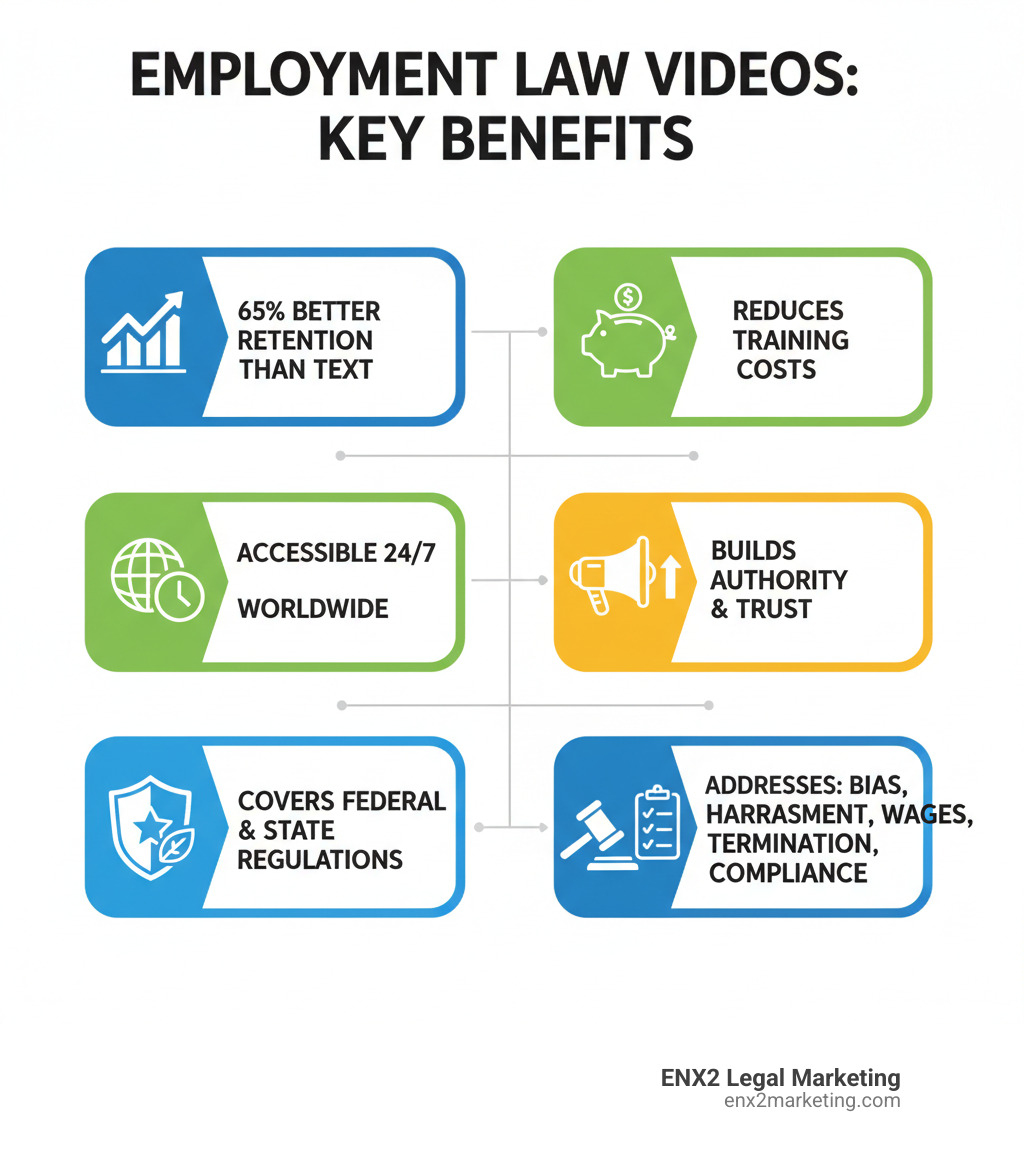
Video is effective because it makes complex legal topics digestible and can boost retention by up to 65%. It offers a cost-effective, on-demand training solution for busy managers and employees. The demand is clear: employment law videos on platforms like YouTube attract millions of views, and law firms are increasingly using video series and tutorials to educate their audiences.
With constantly evolving regulations from the EEOC, NLRB, and DOL, and wide variations in state laws, a single compliance misstep can be costly. Video offers a scalable way to keep teams informed, avoiding expensive training and dense legal texts that few will read.
I’m Nicole Farber, and through my 10+ years leading ENX2 Legal Marketing, I’ve seen how employment law video content helps law firms establish authority while providing genuine value. Video is more than marketing; it’s an educational bridge that clarifies complex regulations for everyone.
The Rise and Benefits of the Employment Law Video
Legal information is often dense and dry, which is why employment law video has become a game-changer. It excels at changing complicated, jargon-heavy legal concepts into understandable content.
Making Complex Legal Concepts Digestible
Studies show that visual learning can boost retention by up to 65% compared to text alone. A well-made employment law video uses real-world scenarios and expert explanations to clarify the nuances of the Family and Medical Leave Act (FMLA) or wage and hour laws. This helps employers understand their obligations regarding discrimination and termination, while employees gain clarity on their rights to fair pay and safe working conditions. The result is a more informed and compliant workplace where everyone understands expectations.

A Compliance and Training Game-Changer for Businesses
For any business, compliance with employment regulations is non-negotiable, and employment law video is an invaluable tool for achieving it. Video training ensures every employee receives the exact same information, which is critical for sensitive topics like harassment prevention and discrimination policies.
Proactive training mitigates risk by educating the workforce on unacceptable behavior and proper reporting channels, building a culture of accountability. This training can cover federal laws like Title VII of the Civil Rights Act of 1964, which prohibits discrimination based on race, color, religion, sex, and national origin, and the Americans with Disabilities Act (ADA), which requires employers to provide reasonable accommodations for qualified employees with disabilities. It also must account for state-specific rules in places like New York, California, or Pennsylvania, which often provide even broader protections. Video training also addresses practical issues like wage and hour laws, which can trigger costly lawsuits if mishandled. Failing to properly classify employees or pay overtime can lead to significant back pay awards, penalties, and expensive class-action litigation. As workplaces evolve with remote and hybrid models, video is an efficient way to distribute updated policies. Finally, comprehensive video training serves as documentation, demonstrating that your company takes compliance seriously and has made a good-faith effort to educate its workforce.
How Legal Experts Use Video for Education and Outreach
For employment law attorneys, video is no longer just a marketing tool; it’s a way to connect with and educate people about their rights. YouTube has become a key platform for legal education, with videos attracting millions of views. Law firms leverage this by creating content to build authority and drive traffic.
Series like “Employment Law This Week®” provide timely updates on developments from the EEOC and NLRB, making complex topics like the new joint-employer rule from the NLRB accessible to a broader audience. Strategically, video makes a firm more approachable, builds credibility, and improves SEO, driving traffic and expanding the firm’s digital reach.
At ENX2 Legal Marketing, we’ve seen how law firm video marketing transforms a firm’s client acquisition. By embracing video, attorneys educate, empower, and build meaningful relationships.

What to Look For: Key Topics and Vetting Your Sources
With so much legal information available online, it’s crucial to find content that is both relevant and trustworthy. Knowing what to look for can help you identify a quality employment law video.
Common Issues Addressed in an Employment Law Video
Effective employment law video content breaks down the real-world workplace issues that matter most to both employers and employees. Key topics often include:
- Discrimination: Explaining protections based on race, gender, age, and disability under federal laws like Title VII and the ADA. A quality video will also cover other protected classes, such as religion, national origin, and pregnancy, and detail the role of the U.S. Equal Employment Opportunity Commission (EEOC) in enforcing these laws. It should also touch on broader state-specific safeguards in places like California and New York, which may protect additional categories like marital status or sexual orientation.
- Harassment: Defining what legally constitutes harassment, differentiating between quid pro quo harassment (where a job benefit is tied to a sexual favor) and a hostile work environment (where severe or pervasive conduct creates an intimidating or offensive atmosphere). The video should also outline proper, confidential reporting procedures and explain protections against retaliation for reporting.
- Wage and Hour Laws: Covering minimum wage, overtime rules under the Fair Labor Standards Act (FLSA), and the critical distinction between exempt and non-exempt employees. This is a common area for employer error, so videos often clarify salary basis tests, duties tests for exemptions, and the legal risks of misclassifying employees as independent contractors. Proper record-keeping for hours worked is another crucial element.
- Non-Compete Agreements & FMLA: Clarifying the enforceability of non-compete agreements, which has become a hot-button issue with the FTC’s recent rule to ban most new non-competes. The video should also explain eligibility and rights under the Family and Medical Leave Act (FMLA), which provides eligible employees with up to 12 weeks of unpaid, job-protected leave per year for specific family and medical reasons.
- Wrongful Termination: Distinguishing between a lawful at-will firing and wrongful termination. This typically involves a breach of an employment contract, discrimination, or illegal retaliation against an employee for engaging in a protected activity, such as whistleblowing or filing a workers’ compensation claim.
- Joint-Employer Rule: Breaking down the complexities of the Navigating the NLRB’s New Joint-Employer Rule, which affects businesses using contractors, staffing agencies, or franchises by potentially making them liable for labor violations committed by their partners.
- Workplace Investigations & DEI: Providing guidance on conducting proper, prompt, and impartial internal investigations into employee complaints. This includes steps like interviewing witnesses, gathering evidence, and documenting findings. It also covers implementing effective diversity, equity, and inclusion (DEI) strategies to foster a more inclusive and respectful workplace culture.
Your Guide to Finding a Credible Employment Law Video
Not all online legal content is reliable. Following inaccurate advice can have serious consequences. Here’s how to vet an employment law video for credibility:
- Check the Source: Is it from a reputable law firm, legal education platform, or news source? Unclear sourcing is a red flag.
- Verify Credentials: Is the presenter a licensed attorney specializing in employment law? General business advice is not a substitute for legal expertise.
- Look at the Publication Date: Employment law changes constantly. Ensure the video is recent enough to be relevant.
- Confirm Jurisdiction: Federal laws apply nationwide, but state laws (e.g., in California, New York, Pennsylvania) vary significantly. Confirm the video covers your specific location.
- Look for Disclaimers: Reputable content will state it is for educational purposes and not legal advice. This shows professional responsibility.
- Cross-Reference Information: Verify critical information with other credible sources, like the EEOC or Department of Labor websites.
While video is a great educational tool, it’s no substitute for personalized legal advice from an experienced employment attorney in your state for specific situations.
Conclusion: Empower Your Firm with Video Marketing
As employment law evolves, so must our communication methods. Employment law video makes complex regulations accessible, helps businesses ensure compliance, and allows legal experts to connect with their audience meaningfully. These videos are a tool for proactive risk management for employers, a source of clarity for employees, and an essential outreach and authority-building strategy for law firms.
At ENX2 Legal Marketing, we have spent over a decade helping law firms, particularly in employment law, harness the power of digital content. We know how to craft video series that build the trust and credibility needed to turn viewers into clients.
Video makes a real difference in how people steer workplace law. If you’re ready to showcase your firm’s expertise in an innovative way, we can help you create video content that educates, engages, and grows your practice.
More info about our attorney video marketing services