

Beyond Intuition – The New Legal Landscape
A data driven law firm moves beyond gut instinct, using analytics and metrics to inform decisions about operations, client services, and growth strategy. This evidence-based approach involves systematically tracking key performance indicators (KPIs), integrating technology like practice management software, and focusing on measurable outcomes that prove ROI.
The legal industry is at a crossroads. Associate attrition has nearly doubled, with the cost to replace a single third-year associate exceeding $1 million when accounting for recruiting fees, training for the new hire, and months of lost productivity. Compounding the problem, 43% of work assignments are based on preference over merit, and nearly half of firms lack complete data on associate capacity. Lawyers bill an average of just 2.9 hours daily, yet many firms don’t even set hourly targets. This gap between available data and actionable insight costs millions in lost revenue and talent. Simultaneously, clients are demanding more for less, pushing for transparent billing, predictable budgets, and measurable efficiency gains that traditional, intuition-based models struggle to provide.
The solution is to accept data. Firms that do see measurable improvements: better resource allocation reduces burnout, transparent billing boosts client satisfaction, and analytics help match the right lawyer to the right case.
I’m Nicole Farber, and over my 12 years building ENX2 Legal Marketing, I’ve helped law firms implement data driven law firm strategies that connect marketing metrics to business outcomes. This shift isn’t just about technology—it’s about building a sustainable, profitable practice that attracts top clients and retains valuable talent.
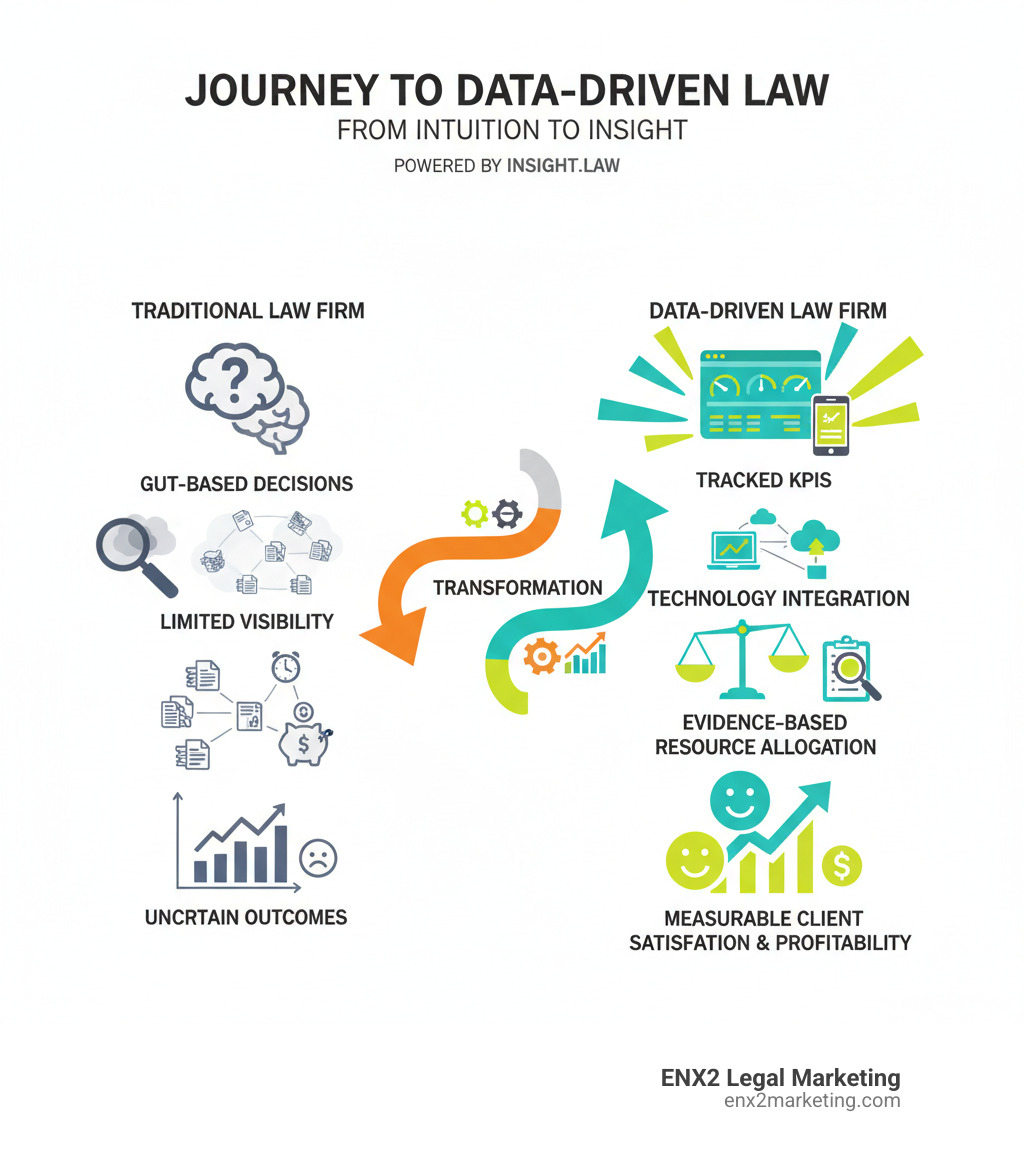
Building Your Data-Driven Law Firm: A Practical Blueprint
Becoming a data driven law firm is about making smarter decisions using information you already have. It’s the difference between thinking something will work and knowing it will because the numbers prove it. Let’s walk through how to build this foundation.
Step 1: Identifying and Collecting Valuable Legal Data
The journey starts with collecting the right information. Think of data as the raw material for better decisions across your practice.
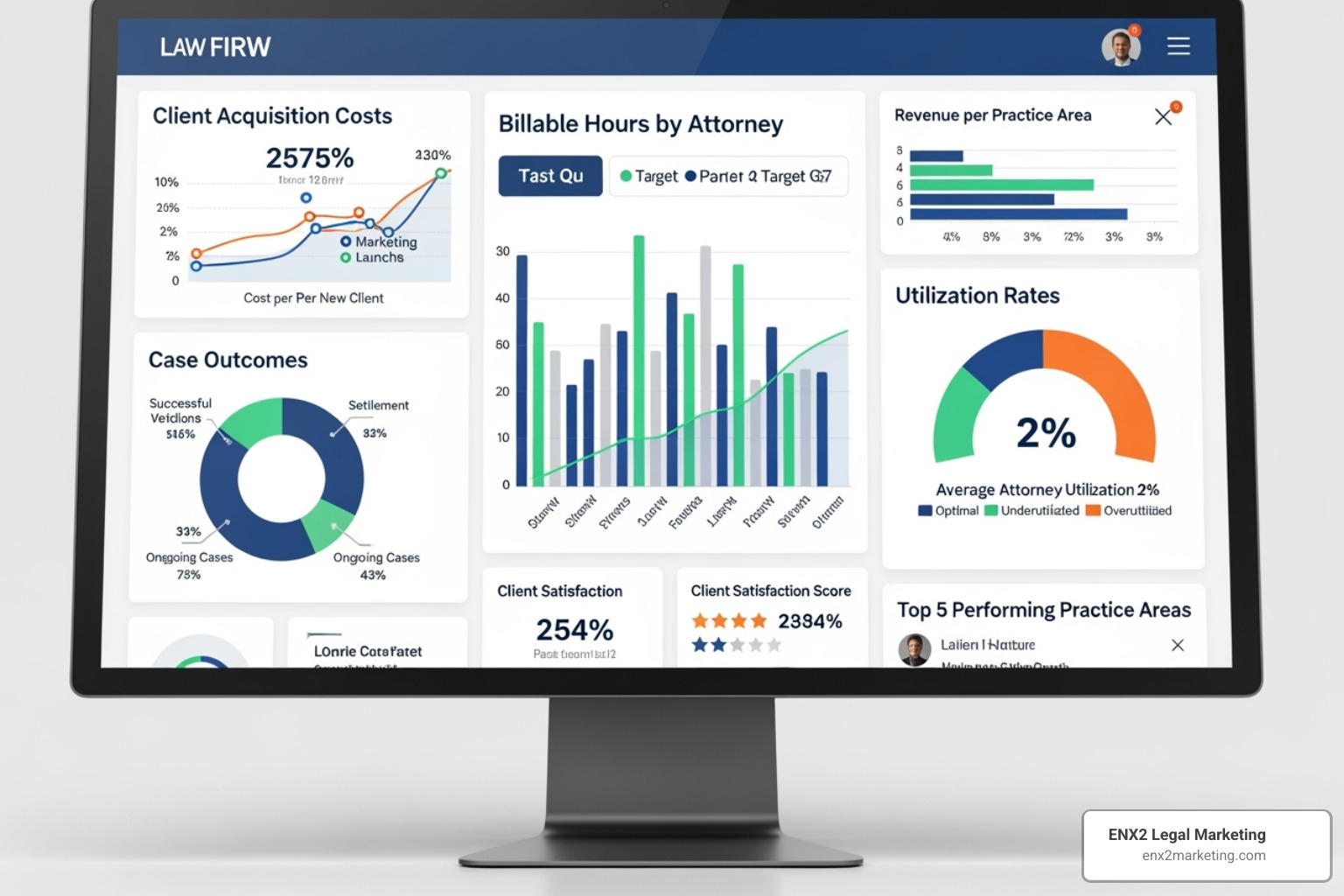
- Operational Data: Track associate utilization, workload distribution, and billable hours. With many firms having only partial data on capacity and lawyers billing just 2.9 hours daily, this is a massive blind spot.
- Financial Data: Go beyond total revenue to analyze profitability by practice area, realization rates (billed vs. collected time), and client acquisition costs.
- Client Data: Monitor intake sources, conversion rates, and satisfaction scores. Since responsiveness is key for clients, tracking communication times is essential.
- Marketing Data: Analyze website traffic, lead sources, and campaign ROI. We’ve seen firms achieve a 251% increase in visitors by tracking what works and optimizing their strategy.
- Talent Data: With associate replacement costs over $1 million, tracking retention and attrition reasons is critical. Data reveals if your work allocation is fair or causing burnout.
Step 2: Leveraging Technology for Actionable Insights
Once you know what to track, technology helps you collect, organize, and analyze it.
- Legal Practice Management Software (LPMS): This is the backbone, automating data collection for billable hours, case progress, and financials in one integrated system.
- CRM Systems: Track every client interaction from first contact to case resolution, ensuring no lead or client need falls through the cracks.
- Analytics and AI: Litigation analytics can reveal lawyer win rates, while AI can help predict case outcomes and automate routine tasks like intake and time tracking. Corporate legal departments are increasingly leveraging these data analytics capabilities to improve efficiency.
Step 3: Optimizing Operations and Client Services
With insights in hand, you can transform how your firm operates. Data-driven resource allocation ensures work is distributed equitably based on capacity and skill, not just partner preference. This reduces burnout and improves fairness. By pinpointing bottlenecks, you can streamline processes, cut overhead, and boost the bottom line. For clients, data allows for personalized service, transparent billing, and proactive communication, dramatically improving satisfaction and retention.
Step 4: Overcoming Challenges and Cultivating a Data Culture
A successful transition requires overcoming key problems.
- Secure Partner Buy-In: Demonstrate tangible ROI by creating a clear business case. For example, show how a 5% increase in realization rates could add hundreds of thousands to the bottom line, or how data-driven staffing can reduce associate burnout and cut turnover costs. Frame data as a tool that enhances, rather than replaces, their expert judgment.
- Prioritize Data Security: Implement robust safeguards like end-to-end encryption, multi-factor authentication, strong access controls, and regular security audits to protect confidential client information and maintain compliance with industry regulations.
- Address Ethical Concerns: Be vigilant about potential biases in historical data. For instance, if past work allocation data shows a skew away from female associates for high-profile cases, using that data to automate future assignments could perpetuate inequality. Actively audit your algorithms and processes to ensure fairness and equity in all data-driven decisions.
- Foster a Data Culture: Leadership must champion the use of data, provide ongoing training, and celebrate wins that were achieved through evidence-based decision-making. Make data literacy a core competency and integrate data discussions into regular team meetings to make it central to your firm’s identity.
Building a data driven law firm isn’t about abandoning legal expertise. It’s about enhancing it with evidence to create a practice that’s more profitable, more efficient, and more valuable to both your team and your clients.
Measuring Success and Fueling Future Growth
Implementing data-driven strategies is an investment, and you need to measure its return. The goal is to track the right metrics to prove its impact on your bottom line.
How to Measure the ROI of a data-driven law firm
To understand the impact, define and track clear success metrics.

Key metrics to track include:
- Profitability Analysis: Which practice areas and client types are most profitable after factoring in all costs?
- Client Retention & Acquisition Cost (CAC): Are clients returning? High retention lowers the effective cost of acquiring each new client.
- Associate Turnover: With replacement costs exceeding $1 million per associate, even small improvements in retention yield massive savings.
- Operational Efficiency: Are case cycle times shortening? Are non-billable administrative hours decreasing?
Benchmark your performance against your own history and industry averages. Consistent tracking—monthly or even weekly—is crucial for identifying trends and making informed adjustments.
The Future is Data: Gaining Your Competitive Edge
The firms that thrive in the next decade will be those that harness data to make smarter, faster decisions. This isn’t a marginal advantage; it’s the difference between guessing and knowing.
Predictive analytics and AI are evolving beyond buzzwords into practical tools. These technologies can analyze thousands of past case files to forecast litigation timelines and potential outcomes with increasing accuracy, helping you set client expectations and develop stronger case strategies. AI can also sift through intake data to identify high-value leads or predict which clients are at risk of churning, allowing for proactive intervention. Furthermore, they can automate routine work like document review, legal research, and time entry, freeing lawyers to focus on high-value strategic counsel. As corporate legal departments already leverage these technologies, client-side expectations for data-informed counsel will only grow, making adoption a necessity for staying competitive.
But as I’ve learned over 12 years building ENX2 Legal Marketing, technology without strategy is just expensive noise. The real power comes from connecting your data in meaningful ways—linking marketing spend to case outcomes, associate utilization to client satisfaction, and billing practices to profitability.
The shift to being a data driven law firm requires a new mindset: asking “what does the data say?” before “what does my gut say?” The firms that accept this change will attract the best talent with fair, merit-based systems and retain the best clients with transparent, efficient service. They will be more profitable because they eliminate the guesswork that drains resources.
Learn how our legal marketing consulting can help you harness your data to build the competitive advantage your firm needs for the future. In the end, the future of law is about using data to build stronger, fairer, and more successful practices.