

The Modern Dilemma of Client Acquisition
Can a lawyer pay for leads? Yes, but it’s a question that demands a careful answer. While lawyers can legally pay for leads, they must follow specific ethical guidelines from the American Bar Association (ABA) to avoid disciplinary action. Here’s a quick overview:
- Pay for advertising and lead generation services under ABA Rule 7.2
- Compensate employees, agents, and vendors for marketing services
- Purchase leads from third-party generators as long as they don’t recommend specific lawyers
- Must avoid fee-splitting with non-lawyers under Rule 1.5(e)
- Ensure transparency in all communications about legal services
For generations, law firms relied on word-of-mouth, community involvement, and the Yellow Pages to attract clients. But the digital revolution has fundamentally altered how people find legal help. Today, a potential client’s first step is often a Google search, not a call to a friend. This shift has created an urgent need for lawyers to engage in online marketing, but the ethical rules, written for a pre-internet era, haven’t always kept pace. This creates a complex ethical landscape where the line between permissible advertising and improper solicitation can seem blurry. Navigating the rules of professional conduct is critical—make the wrong move, and you risk sanctions from your state bar. Ignore it, and you risk falling behind.
I’m Nicole Farber, CEO of ENX2 Legal Marketing. For over a decade, I’ve helped law firms answer the question of can a lawyer pay for leads while staying compliant. The most successful firms understand both the opportunities and the boundaries of modern legal marketing.
So, Can a Lawyer Pay for Leads? The Ethical and Legal Framework
The short answer is yes—can a lawyer pay for leads—but with important ethical guardrails. What works for other industries might land a lawyer in hot water. The key is understanding the specific rules for the legal profession.
The Letter of the Law: Understanding ABA Model Rules
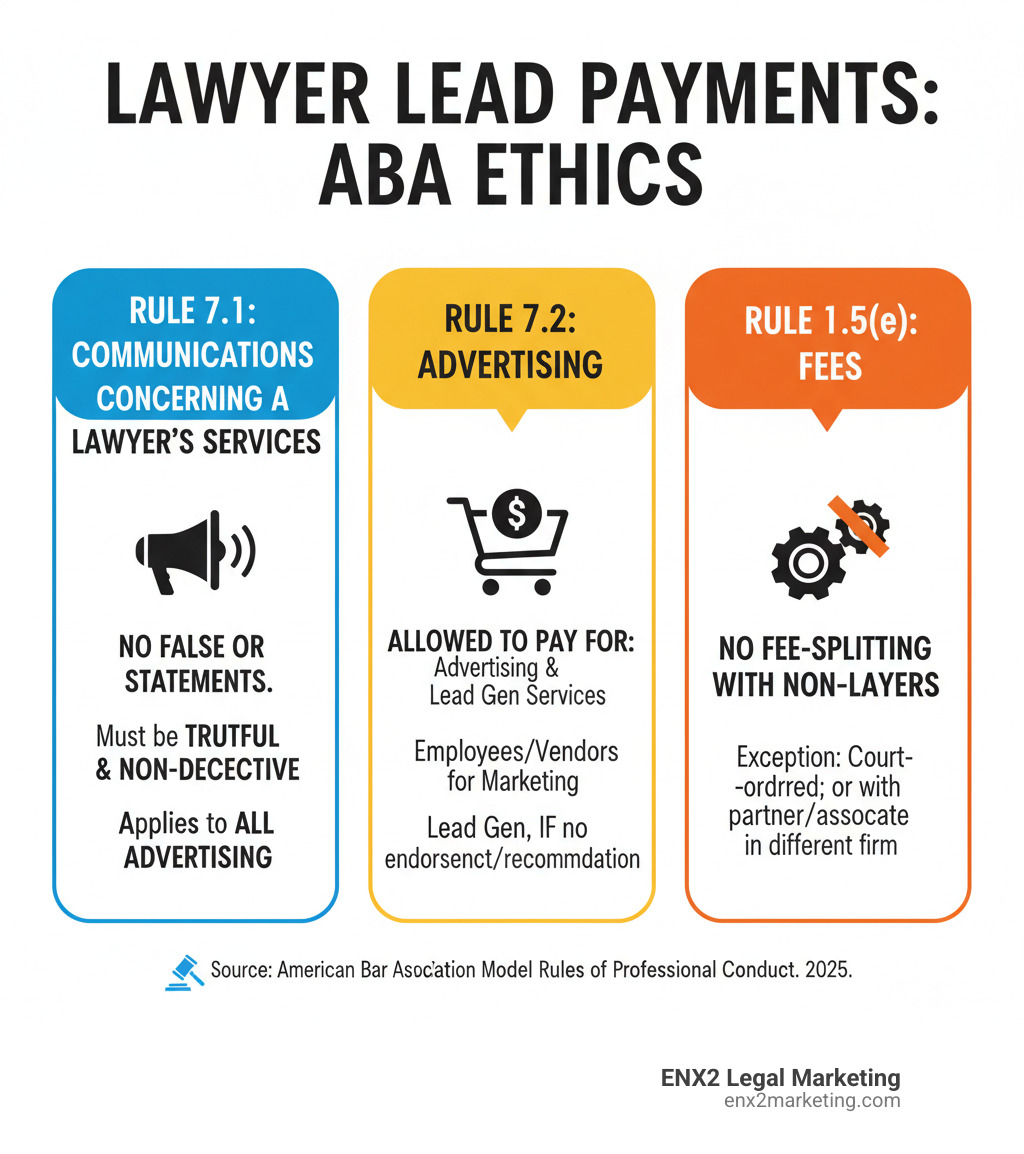
The American Bar Association (ABA) Model Rules provide our ethical roadmap. Three rules are central to lead generation:
-
ABA Rule 7.2 explicitly allows lawyers to “pay others for generating client leads, such as Internet-based client leads.” The crucial catch is that the lead generator cannot recommend you specifically. They act as a directory or matching service, not a personal endorser. This means the service can list your qualifications and contact information, but it cannot state that it has vetted your skills and is personally vouching for you over other attorneys. You can review the specifics directly at ABA Rule 7.2.
-
Rule 1.5(e) prohibits fee-splitting with non-lawyers. You can pay a flat fee per lead or a monthly retainer for marketing services, but you cannot give a lead generation company a percentage of your legal fees. The payment must be for the marketing service, not a slice of the case’s outcome. The rationale behind this rule is to protect the lawyer’s professional independence of judgment. When a non-lawyer has a financial stake in the outcome of a case, it can create pressure to settle or make decisions that are not in the client’s best interest. More details are in Rule 1.5(e).
-
Rule 7.1 requires all communications to be truthful and not misleading. This applies to any lead generation company you work with. They cannot imply they’ve analyzed a legal problem or are personally recommending you.
State bar associations often adopt these rules with their own variations, like Pennsylvania Code Rule 7.2. Always check your state’s specific requirements.
Paid Leads vs. Traditional Referrals: What’s the Difference?
Understanding this distinction is critical. Both bring in clients, but they operate under different ethical rules.
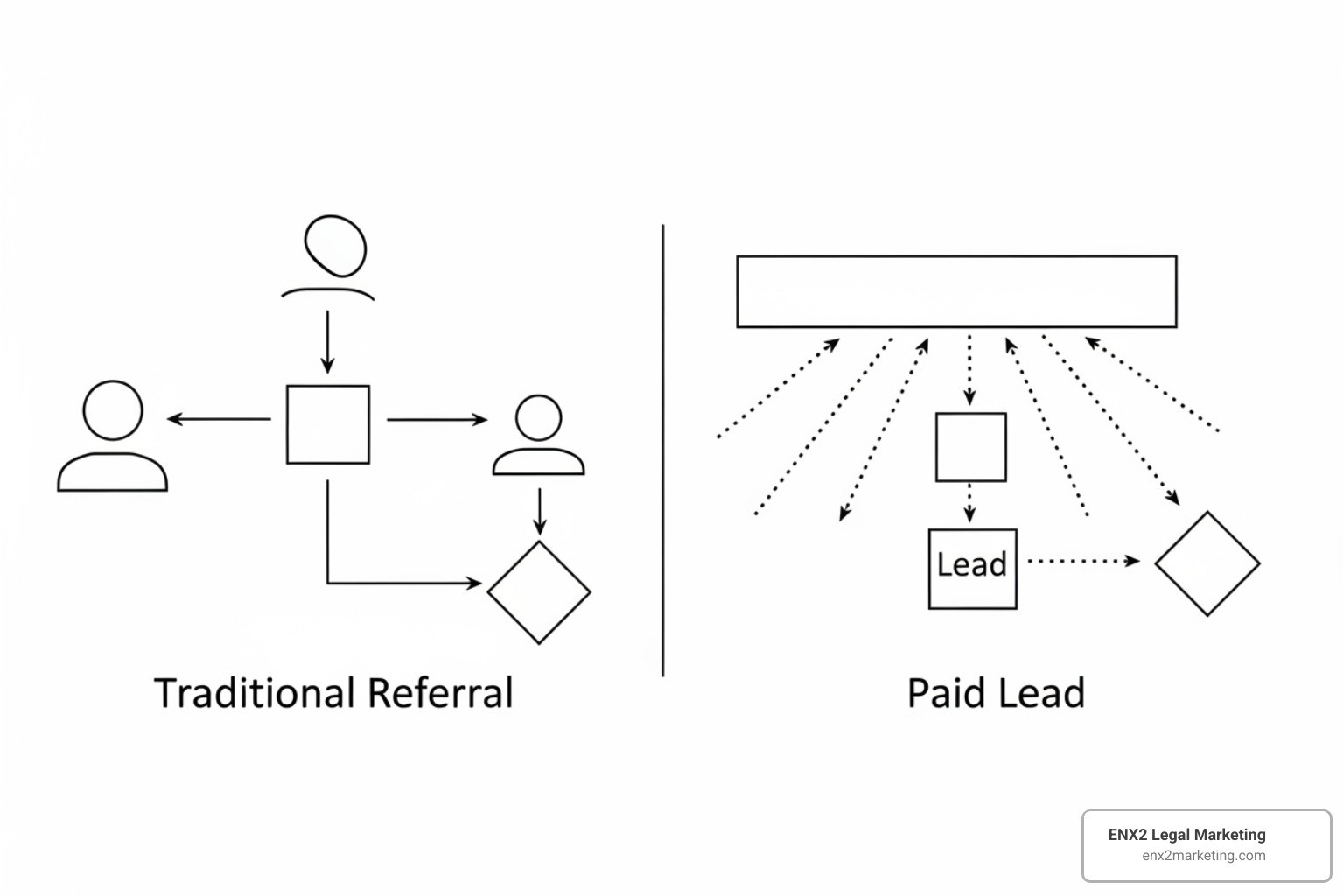
Traditional referrals often involve one attorney sending a client to another, sometimes with a referral fee (a percentage of the legal fee). This fee-sharing between lawyers is permissible under specific conditions.
Paying for leads is a marketing expense. You’re buying access to potential clients who have expressed interest, not paying for a recommendation. The lead generator simply facilitates a connection, which keeps you compliant with fee-splitting prohibitions.
Navigating Lead Generation Models: Pay-Per-Lead vs. Pay-Per-Click
When lawyers ask can a lawyer pay for leads, they’re usually considering two models: Pay-Per-Lead (PPL) and Pay-Per-Click (PPC).
Pay-Per-Lead (PPL) means you pay a set amount for each qualified contact. The appeal is clear: you only pay for a potential client. However, lead quality can vary, and some leads are shared among multiple attorneys, creating a race to respond first.
Pay-Per-Click (PPC) involves paying each time someone clicks your ad on platforms like Google. You’re not guaranteed a lead, but you gain control. With PPC, you can target specific keywords and demographics, adjust messaging, and build your brand. The data from PPC campaigns allows for continuous optimization. Our PPC Management for Law Firms service focuses on this data-driven approach to maximize your advertising spend.
Both models can be effective. PPL offers speed, while PPC, like our Lawyer Pay Per Click Advertising, provides strategic control and brand-building opportunities.
How can a lawyer pay for leads while ensuring quality?
The legal industry has many questionable lead generation companies. To avoid wasting money on low-quality leads, rigorous vetting is essential.

Here’s a quick vetting guide:
- Research the Provider: Look for established companies with case studies and references.
- Understand Their Methods: How do they generate leads? Transparent companies will explain their process.
- Check for Exclusivity: Exclusive leads go only to you, increasing conversion chances. Shared leads are sold to multiple firms.
- Examine Their Validation Process: Quality providers pre-screen inquiries to ensure they match your practice areas.
- Demand Real-Time Delivery: Leads go stale quickly. Immediate delivery via email, phone, or CRM is crucial.
- Verify Ethical Compliance: Ensure the company understands and adheres to ABA rules.
- Track Your Results: Monitor lead quality, conversion rates, and cost per signed case to optimize your strategy.
Successfully paying for leads requires careful planning and constant monitoring. Our Attorney Lead Generation Services prioritize both ethical compliance and lead quality to ensure a strong return on investment.
Building a Sustainable Growth Engine: Beyond Buying Leads
While the answer to can a lawyer pay for leads is yes, the smartest firms don’t stop there. Purchased leads are like renting your client pipeline; organic lead generation is like owning it. When you stop paying, the leads stop. When you invest in your own lead generation engine, you create assets that deliver long-term value.
The In-House Alternative: Generating Your Own Leads
Generating your own leads isn’t just about saving money—it’s about building a brand that clients trust.

As the graph shows, paid campaigns provide a temporary spike, while organic efforts build compounding momentum. Here are the core components of an in-house engine:
-
Search Engine Optimization: This is your foundation. Ranking high in search results for terms like “divorce attorney near me” ensures that people who need your help can find you.
-
Content Marketing: By publishing helpful articles, you become a trusted advisor, not just a vendor. Our approach to Content Marketing for Lawyers focuses on creating content that answers client questions and builds authority.
-
Social Media & Email Marketing: These channels build human connections and keep your firm top-of-mind, so when a potential client has a need, they think of you first.
-
Online Presence Optimization: A professional, fast, and easy-to-steer website is crucial for converting visitors into leads.
This integrated approach creates a virtuous cycle where each element reinforces the others, building a powerful and sustainable growth engine over time.
The Final Verdict: Is Paying for Leads Worth It for Your Firm?
After more than a decade in legal marketing, I’ve learned the best strategies are not either-or, but both-and. Paying for leads has its place, especially when you need speed and scalability.
However, there are significant considerations. Quality control remains a major challenge, as many lead providers prioritize quantity over quality. An over-reliance on purchased leads can also leave your firm vulnerable; if costs rise, quality drops, or a key provider goes out of business, your client pipeline could dry up overnight. To make an informed decision, it’s crucial to understand the typical costs involved, which vary dramatically by practice area and geographic location.
| Practice Area | Cost Per Lead Range |
|---|---|
| Personal Injury | $150 – $500+ |
| Mass Torts | $300 – $1,000+ |
| Medical Malpractice | $200 – $800 |
| Family Law | $50 – $200 |
| Bankruptcy Law | $75 – $300 |
These are costs per lead, not per client. Your true cost per acquisition (CPA) will depend on your firm’s intake process and conversion rate. For example, if you pay $200 for a personal injury lead and your firm converts 1 out of every 10 leads into a signed client, your CPA is $2,000. The high potential value of these cases can justify the cost, but only if your firm has an efficient system to follow up, qualify, and sign these leads. This is why tracking metrics beyond just the initial cost per lead is absolutely critical for determining ROI.
The winning approach is a balanced one: use purchased leads for immediate results while simultaneously building your organic engine for long-term, sustainable growth. This diversified strategy protects you from market volatility and creates a resilient client acquisition system.
At ENX2 Legal Marketing, we specialize in creating this balanced approach. Our Attorney Lead Generation Services deliver quality leads today, while our SEO and content services build your pipeline for tomorrow. The question isn’t just can a lawyer pay for leads, but how to build an ethical and profitable system that serves your firm for years to come. That’s where our expertise makes the difference.