

Your Digital Handshake: Why Every Law Firm Needs a Professional Website
When you build law firm website, you’re creating the digital front door to your practice. With 96% of potential clients using search engines to find legal advice, your website is often the first—and most critical—interaction they’ll have with your firm.
Quick Guide to Build Law Firm Website:
- Essential Pages: Homepage, About Us, Practice Areas, Attorney Bios, Contact
- Technical Requirements: Mobile-responsive design, SSL security, fast loading
- Content Strategy: Client testimonials, case results, legal resources
- SEO Foundation: Local keywords, Google Business Profile optimization
- Lead Generation: Contact forms, appointment booking, live chat options
- Compliance: ADA accessibility, legal disclaimers, privacy policies
Your law firm’s website isn’t just an online brochure—it’s your most powerful marketing tool. A well-designed site builds trust, showcases expertise, and converts visitors into clients. Without a professional online presence, you’re invisible to the vast majority of people seeking legal services.
The challenge? Most attorneys aren’t web developers. Creating a website that generates cases requires a deep understanding of legal marketing and technical implementation. The process can feel overwhelming, but you don’t have to figure it out alone.
I’m Nicole Farber, and over the past 12 years building ENX2 Legal Marketing, I’ve helped countless law firms build law firm website solutions that convert. My experience has shown me exactly what works when creating a digital presence that grows your practice.
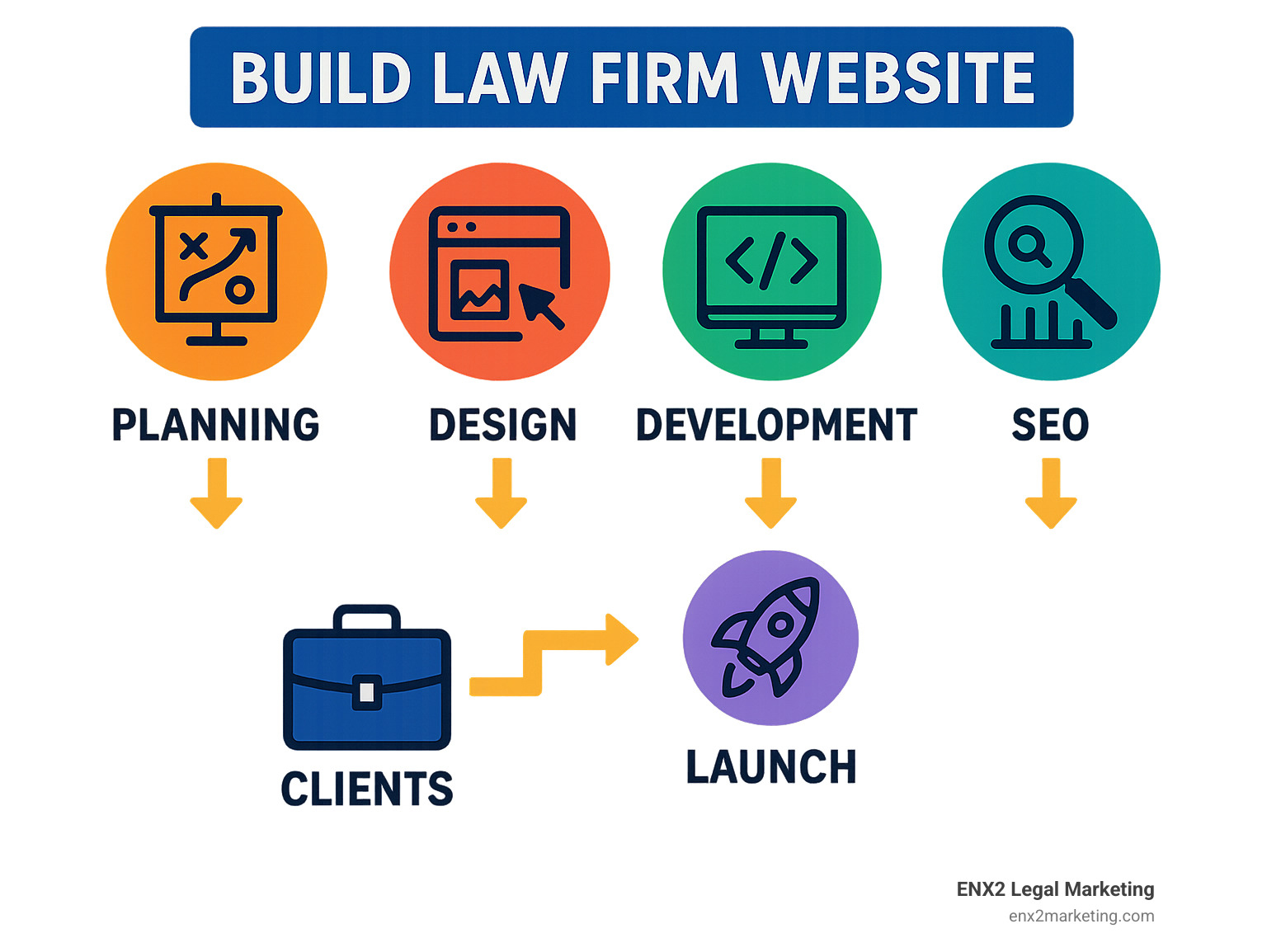
The Ultimate Guide to Build a Law Firm Website That Converts
Picture a potential client searching for legal help late at night on their phone. Your website is your firm’s most hardworking employee, available 24/7 to make that crucial first impression and guide worried clients toward a solution.
When you build law firm website that truly converts, you’re creating a bridge between someone’s legal problem and your expertise. The difference between a site that just sits there and one that brings in cases comes down to four key elements: essential content, user-focused design, solid technical implementation, and a smart lead generation strategy.
Let’s walk through how to get each piece right.
Laying the Foundation: What to Include When You Build a Law Firm Website
Before worrying about aesthetics, you need a strong foundation. When we build law firm website projects, we always start with the essential pages every successful legal site needs.

- Homepage: Your digital lobby. It must immediately answer: who you are, what you do, and how you help. Use clear, human language, not legal jargon.
- About Us & Attorney Bios: This is where you build connection and trust. Go beyond a dry list of credentials; use professional headshots and share the authentic stories and motivations behind your practice. Why did you become a lawyer? What drives your firm’s mission? Answering these questions helps humanize your practice. Potential clients are often in a state of distress; connecting with the person behind the law degree can make all the difference. Remember, clients hire people, not just resumes.
- Practice Areas: Each service needs its own page. Explain the client’s problem and how you solve it. Include relevant (and anonymized) case results and testimonials to build credibility.
- Blog/Resources: A cornerstone of any Law Firm Content Marketing Strategy, a blog showcases your expertise and provides valuable information that attracts potential clients through search engines.
- Contact Page & Testimonials: Make it incredibly easy to get in touch with multiple contact methods. Sprinkle client testimonials throughout your site as powerful social proof.
- Consistent Branding: Tie everything together with a cohesive visual identity (colors, fonts, logo) that reinforces your firm’s professional image and values.
Designing for Success: User Experience and Mobile-First Principles
Great design isn’t about winning awards—it’s about making it easy for stressed people to find what they need. When you build law firm website with user experience in mind, every choice should serve your visitors.

- Simple Navigation: Organize your site logically. A potential client shouldn’t have to hunt for the information they need.
- Clear Calls to Action (CTA): Use prominent buttons and links like “Get Help Now” or “Schedule a Free Consultation” to guide visitors to the next step.
- Readability and Aesthetics: Use legible fonts, ample white space, and a clean, professional layout. High-quality imagery builds trust, while cluttered designs create friction. When it comes to the Best Law Firm Web Design, simplicity wins.
- Mobile-First Design: This is non-negotiable. With the vast majority of clients starting their search on a smartphone, often in urgent situations, your website must be fully mobile-responsive. This means the layout, text, and buttons automatically adjust for a seamless experience on any screen size. Google’s algorithm explicitly prioritizes mobile-friendly sites, so a poor mobile experience directly harms your user engagement and, consequently, your search rankings. Following Google’s mobile-first and SEO starter guidance and monitoring key performance metrics like Core Web Vitals is critical for digital survival. Use free tools like PageSpeed Insights to diagnose and fix performance bottlenecks that could be turning mobile visitors away.
The Technical Side of How to Build a Law Firm Website
The technical backend of your site is just as important as its design. Your main choice is between a template and a custom build.
- Templates vs. Custom: Law Firm Website Builders offer templates that are affordable and quick to launch, but they can look generic and have limitations. A Custom Web Design for Attorneys offers a unique, scalable solution perfectly custom to your brand, though it requires a larger upfront investment. The right choice depends on your budget, timeline, and long-term goals.
- Core Essentials: Choose a memorable domain name that reflects your firm. Invest in reliable, fast website hosting. Always serve your site over HTTPS—see Google’s guidance on securing your site with HTTPS—to encrypt data and build trust with users and search engines.
- Security and Accessibility: An SSL certificate is mandatory to encrypt data and build trust (with both users and Google). Furthermore, ensuring your site is ADA compliant is not only the right thing to do but also protects your firm from potential legal issues. Review the U.S. Department of Justice’s web accessibility guidance and the W3C’s WCAG standards.
- Structured Data: Implement local business structured data to help search engines understand your firm and improve local visibility—see schema.org/LegalService and Google’s Local business structured data.
Fueling Growth: SEO and Lead Generation Strategies
A beautiful website is only effective if potential clients can find it. That’s where SEO and lead generation come in.

- SEO Foundation: Start with keyword research to find the phrases your clients use. Weave these terms naturally into your site’s content (on-page SEO). For most firms, Local SEO is the key to attracting nearby clients. This means fully optimizing your Google Business Profile, ensuring your contact information is consistent online, and actively gathering client reviews. This strategy helps you stand out from the competition. Our comprehensive Law Firm SEO Guide dives deeper into these strategies.
- Lead Generation Tools: Convert visitors into leads. Use simple contact forms, offer live chat for immediate assistance, and integrate appointment scheduling tools to eliminate back-and-forth. The goal is to remove every barrier between a person needing help and contacting your firm, a key part of Optimizing Your Law Firm Website Without Losing Your Mind.
Conclusion: Launching and Maintaining Your Digital Presence
You’ve just walked through the roadmap to build law firm website that doesn’t just exist—it performs. From foundational pages to mobile-first design, you now understand what separates a digital brochure from a client-generating machine.
However, launching your website is just the beginning. A high-performing site is a living asset, not a “set it and forget it” project. It needs regular care to stay competitive and effective.
Content freshness is vital. Regularly publishing new blog posts and resources keeps search engines and potential clients engaged, reinforcing your authority. Performance monitoring using analytics tools tells you what’s working and where you can improve, allowing for data-driven decisions. Finally, ongoing website maintenance—updating software, fixing broken links, and ensuring security protocols are current—is critical for functionality, speed, and protecting your firm’s reputation.
To manage performance and visibility, set up Google Analytics 4 to track conversions and behavior, and use Google Search Console to monitor indexing, Core Web Vitals, and search queries. These free tools show you which pages attract clients, where users drop off, and what to improve next.
A simple ongoing maintenance checklist:
- Update your CMS, plugins, and dependencies monthly.
- Review Core Web Vitals and load times quarterly.
- Audit accessibility against WCAG and ADA guidance biannually.
- Refresh top pages with new proof points (testimonials, case results) regularly.
- Back up your site and test restoration workflows on a schedule.
At ENX2 Legal Marketing, we’ve spent over a decade helping law firms transform their digital presence. We don’t just build beautiful websites; we build strategic assets that generate real cases for our clients.
The legal landscape has evolved. Clients expect to find you online. Don’t let an outdated or ineffective website cause you to lose potential clients to competitors. Your expertise deserves a digital presence that matches its value.
Ready to build a website that wins cases? Explore our law firm website design services.