

DC family law: Your Essential 2026 Guide
Introduction: Navigating Family Legal Matters in the District
DC family law governs the legal issues affecting families in Washington D.C., from divorce and child custody to domestic violence protection. These sensitive matters are handled by the D.C. Superior Court’s Family Court Operations Division, located at the Moultrie Courthouse (500 Indiana Avenue, NW). A key principle is “one family, one judge,” which assigns a single judge to cases involving the same family to ensure consistency.
The court manages a high volume of cases, and a staggering number of people steer this system alone. In divorce and custody cases, 83% of plaintiffs and 93% of respondents represent themselves (pro se). This guide will walk you through the DC family law system, from case types and filing procedures to the many resources available to District residents.
I’m Nicole Farber, and my expertise is in legal digital marketing. For over a decade, I’ve helped DC family law attorneys connect with clients, giving me deep insight into the challenges families face. Whether you’re considering divorce, establishing custody, or seeking protection, understanding your options is the first step toward resolution.
If you want to read the governing rules for many of these cases, you can review the D.C. Code provisions on domestic relations and the D.C. Superior Court Rules Governing Domestic Relations Proceedings, which explain procedures for divorce, custody, and support.
The Core of DC Family Law: Cases, Courts, and Procedures

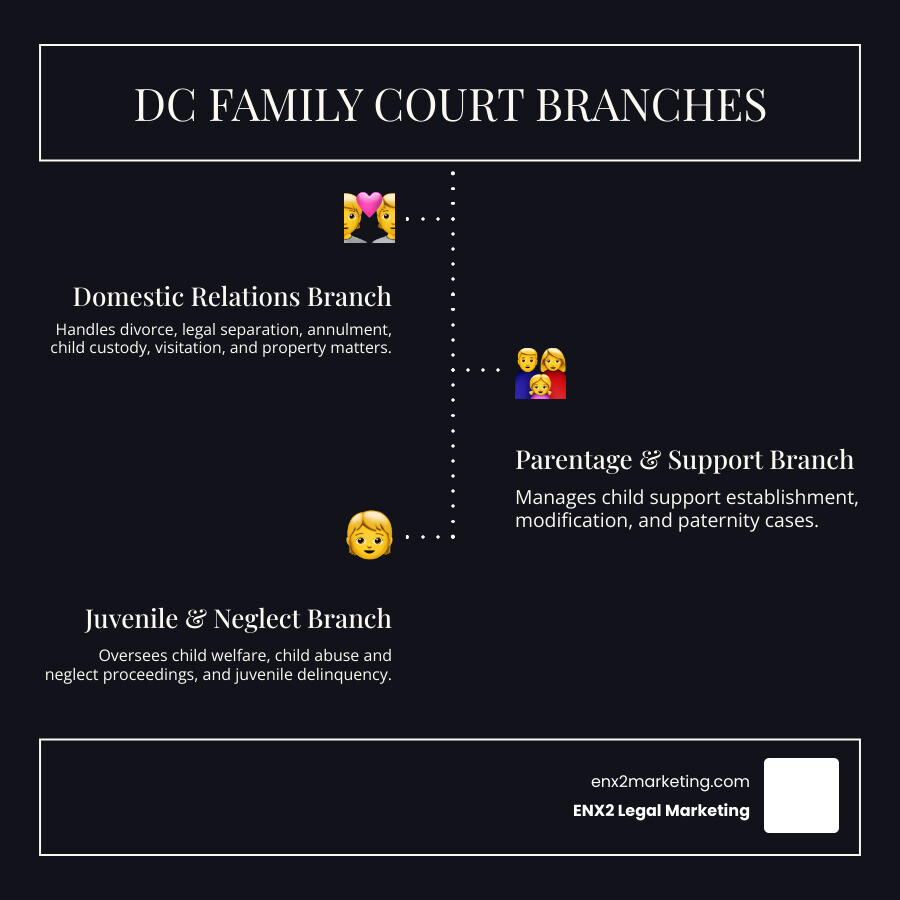
The D.C. Superior Court’s Family Court Operations Division handles a wide array of family-related legal issues. The main case types include divorce, legal separation, annulment, child custody and support, paternity, domestic violence protection orders, adoption, and guardianship. Each case type follows specific procedures and timelines that are crucial for parties to understand. You can find a broader overview of these cases on the Family Matters | District of Columbia Courts page.
For a more general background on family law concepts that apply in many states, you can review the U.S. Department of Health & Human Services child welfare resources, which explain nationwide trends and policies around custody, safety, and support. Understanding both local and federal frameworks helps parties better navigate their specific situations.
The Divorce Process: Separation, Annulment, and Dissolution
When a marriage ends, D.C. law offers several paths. The process begins by filing a complaint at the court’s Central Intake Center (CIC). D.C. is a no-fault divorce jurisdiction, so you don’t need to prove misconduct. The primary grounds are based on separation:
- Mutual Consent: Parties can file for divorce after living separate and apart for at least six months. This option requires both parties to agree to the divorce and sign a settlement agreement addressing all issues.
- One-Year Separation: If there is no mutual consent, parties must live separate and apart for at least one year. During this time, couples can still share the same residence if they maintain separate lives.
Legal separation allows couples to live apart with court-ordered rights and obligations (like support and property division) but remain legally married. This option is often chosen for religious reasons or to maintain insurance benefits. An annulment declares a marriage void, as if it never happened, and is only granted in specific cases like fraud, bigamy, or when one party was under the legal age to marry without proper consent.
During a divorce, D.C. courts divide marital property and debt based on “equitable distribution,” which means fairly, but not necessarily 50/50. The court considers factors such as the duration of the marriage, each party’s contribution to marital property, economic circumstances, and whether either party dissipated marital assets. Separate property acquired before marriage or through inheritance generally remains with the original owner. You can find all necessary forms on the court’s Divorce, Legal Separation, and Annulment Forms page.
Child Custody, Visitation, and Support in DC Family Law

In any case involving children, DC family law prioritizes the “best interests of the child.” The court determines both legal custody (decision-making authority for education, health, religion, and extracurricular activities) and physical custody (where the child lives day-to-day). These can be awarded solely to one parent or jointly to both. Joint legal custody is common in D.C., allowing both parents to participate in major decisions affecting their children.
When determining custody, the court considers multiple factors including the wishes of the child (if of sufficient age and maturity), the parents’ wishes, the child’s relationship with each parent and siblings, the child’s adjustment to home, school, and community, and the mental and physical health of all parties involved. The court may also consider any history of domestic violence or substance abuse.
Child support is calculated using D.C.’s guidelines, which consider parental income, the number of children, and custody arrangements. The guidelines use a formula based on the combined income of both parents and the percentage of time each parent has physical custody. The goal is to ensure the child receives financial support from both parents proportionate to their ability to pay. Support typically continues until the child turns 21 or becomes emancipated. For help, the Child Support Resource Center Hotline is a valuable resource.
If a significant change in circumstances occurs (like a job loss, relocation, or change in the child’s needs), either parent can file a motion to modify existing custody or support orders. The requesting party must demonstrate that the change is substantial and warrants court intervention.
If you want more context about how child support generally works across the U.S., the federal Office of Child Support Services provides educational materials about enforcement tools, payment options, and parents’ rights and responsibilities.
Navigating the Court System: Filing, Fees, and Service
All family law cases start at the Central Intake Center (CIC) on the JM level of the Moultrie Courthouse. The standard filing fee for a new divorce, custody, or support case is typically $80, though fee waivers are available for those who qualify based on income. The court requires specific forms for each type of case, and incomplete filings will be rejected.
After filing, you must “serve” the legal documents on the other party to provide formal notice of the lawsuit. According to the Rules Governing Domestic Relations Proceedings, this can be done through personal delivery by a process server or law enforcement, certified mail with return receipt requested, or other court-approved methods. Service must be completed within specific timeframes, typically 60 days from filing.
Once service is complete, you must file a “proof of service” with the court showing when and how the documents were delivered. The other party then has 20 days to respond if served in D.C., or 30 days if served outside the District. Failure to respond can result in a default judgment. The D.C. Courts website and the Family Court Self-Help Center are excellent resources for finding the correct forms and understanding these procedures.
Finding Help: Legal Aid and Resources in Washington D.C.
Given the high number of people representing themselves, finding affordable legal assistance is critical. Fortunately, D.C. has a robust network of free and low-cost resources to help you steer the complexities of DC family law.
Free and Low-Cost Legal Assistance
The Family Court Self-Help Center at the Moultrie Courthouse offers free walk-in assistance, providing legal information and help with completing court forms for divorce, custody, and other family matters.
For more direct representation, the Family Law Assistance Network (FLAN) is a key resource. A collaboration between the D.C. Bar Pro Bono Center, DC Affordable Law Firm, and Legal Aid DC, FLAN provides advice and representation to low-income individuals (typically under 200% of federal poverty guidelines). They assist with custody, support, and divorce cases, offering services remotely and in person at the courthouse.
Other vital organizations providing free legal services in D.C. include:
- Legal Aid DC: The city’s oldest and largest provider of free civil legal services for low-income residents.
- Neighborhood Legal Services Program (NLSP): Offers free legal assistance in civil matters, including family law.
- LawHelp-DC: A comprehensive online portal to find legal information and connect with aid organizations.
Specialized Support for Domestic Violence Cases
Domestic violence cases require specialized support. A Civil Protection Order (CPO) is a crucial tool that can order an abuser to stay away and refrain from contact. Several organizations focus on helping survivors:
- D.C. Volunteer Lawyers Project (DCVLP): Mobilizes volunteer attorneys to represent domestic violence survivors in family law cases.
- Network for Victim Recovery of D.C. (NVRDC): Provides legal advocacy and holistic services to victims of crime.
Resources are also available for respondents in domestic violence cases to ensure their rights are protected. Organizations like Rising for Justice may provide legal assistance to help respondents steer the legal process. It is crucial for anyone involved in a domestic violence case to seek legal counsel.
Conclusion: Taking the Next Step
Navigating DC family law is challenging, but you don’t have to do it alone. From the Family Court Self-Help Center to specialized legal aid groups, a wealth of resources is available to provide guidance and representation. Understanding your options and seeking timely help is the first step toward a just resolution for your family.
If you’re a law firm specializing in DC family law and want to connect with clients who need your expertise, we at ENX2 Legal Marketing understand these challenges. Let us help you empower more individuals with access to justice.
Get expert help with your firm’s family law lead generation