

Why Law Firm Growth Strategies Matter More Than Ever
Law firm growth strategies are critical for building a profitable practice in today’s legal market. Research shows a staggering 43% of law firms fail—not due to a lack of legal skill, but because they never learn to run their practice like a business. The difference between struggling and thriving is treating your firm as a strategic enterprise, not just a collection of cases.
Growth means avoiding the “feast or famine” cycle that plagues so many firms. It requires a proactive approach built on a solid foundation. The legal market is evolving, with its tech sector projected to reach $32.54 billion by 2026. Firms using modern tools like online payments and client portals earn 20-39% more revenue per lawyer. Meanwhile, a shocking 67% of firms don’t respond to prospect emails, leaving a massive opportunity for those who prioritize client experience.
I’m Nicole Farber, and at ENX2 Legal Marketing, I’ve spent over a decade helping law firms implement these strategies. This guide provides a complete roadmap for sustainable growth, changing practices into thriving businesses.
The Blueprint for Sustainable Law Firm Growth Strategies
This section details the actionable strategies for building a scalable, profitable practice, moving from foundational planning to advanced operational and marketing tactics.
Building the Foundation: Strategic Planning and Leadership
A growing law firm needs a robust business plan. Firms with one are 30% more likely to hit their goals. This plan is your compass, guiding every decision. Start with a SWOT Analysis (Strengths, Weaknesses, Opportunities, Threats) to understand your position. For example, an opportunity might be the growing demand for litigation services, which saw a 3.3% increase in 2024.
Next, set SMART goals (Specific, Measurable, Achievable, Relevant, Time-bound) and define your Unique Value Proposition (UVP). What makes your firm stand out? Your UVP clarifies who you serve, what problems you solve, and why you’re the best choice. A critical component of this is defining your ideal client and potentially niching down. While it may seem counterintuitive to narrow your focus, firms that specialize in a specific practice area or serve a particular industry often command higher fees, attract more qualified leads, and build a stronger reputation. This focus simplifies your marketing efforts and positions you as the go-to expert. This feeds into your organizational structure, clarifying roles and enabling proactive hiring to manage growth without becoming overwhelmed. Finally, leadership must drive this change, investing in business training and moving away from outdated partner compensation models that stifle collaboration.
Effective Law Firm Growth Strategies for Marketing and Client Acquisition
Sophisticated, client-centric marketing is non-negotiable. It begins with a strong brand identity and an optimized online presence. Your website is your digital storefront; it must be professional, fast, and mobile-friendly. Search Engine Optimization (SEO) is critical for visibility, especially local SEO for firms in competitive markets like Philadelphia or Scranton. For a deeper dive, check out this comprehensive SEO guide for lawyers.
Content marketing, through blogs and FAQs, establishes you as a thought leader. With 63.8% of the world’s population on social media, platforms like LinkedIn are essential for building authority. Beyond organic efforts, consider a targeted paid advertising strategy using Google Ads or social media ads to reach potential clients actively searching for your services. Furthermore, video marketing—through client testimonials, legal explainers, or attorney bios—can significantly boost engagement and build trust faster than text alone. However, marketing is intertwined with client experience. Happy clients become your best referral source, and 84% of B2B sales start with a referral. Yet, a staggering 67% of law firms don’t respond to prospect emails. To stand out, prioritize responsiveness:
- Respond Within 24 Hours: Acknowledge all inquiries promptly.
- Use Client Portals: Offer clients convenient, secure access to case information.
- Automate Intake: Allow prospects to schedule consultations directly from your website.
- Designate a Point Person: Ensure someone is responsible for monitoring all inquiries.
- Communicate Proactively: Lead with empathy and keep clients informed.
Retaining clients is far more cost-effective than acquiring new ones. Nurturing existing relationships is one of the smartest growth strategies available.
Operational Law Firm Growth Strategies: Systems, Tech, and Talent
To avoid the “feast or famine” cycle, you need efficient operations. Technology is the engine of modern law firm efficiency, with the legal tech market projected to hit $32.54 billion by 2026. Adopting new tech increases efficiency for 64% of firms.

Firms using tools like online payments, client portals, and intake solutions earn 20-39% more revenue per lawyer. AI is also a game-changer for legal research and document drafting. But tech alone isn’t enough. You need Standard Operating Procedures (SOPs)—step-by-step instructions for every repeatable task. SOPs ensure consistency, reduce errors, and make delegation seamless. Effective delegation frees you from being the bottleneck, allowing you to focus on high-value work.

Finally, invest in your talent. A positive work culture isn’t just a buzzword; it’s a strategic asset. This means creating clear career progression paths, offering mentorship programs, and fostering an environment of open communication and feedback. When your team feels valued and sees a future at your firm, they become more invested in its success. Competitive compensation and benefits are the baseline, but professional development opportunities and a healthy work-life balance are what truly differentiate a firm as an employer of choice and reduce costly turnover. These are the people who will power your growth.
Measuring Success with Data-Driven Decisions and Financial Planning
Growth isn’t a miracle; it’s math. Move beyond guesswork by tracking Key Performance Indicators (KPIs) to understand your firm’s performance. Key metrics include:
- Client Acquisition Cost (CAC): How much it costs to gain a new client.
- Revenue per Employee (RPE): A measure of team productivity.
- Realization Rate: The percentage of billable hours collected.
- Client Lifetime Value (CLV): The total revenue a client is expected to generate over the course of their relationship with your firm. A high CLV indicates strong client satisfaction and retention.
- Net Promoter Score (NPS): A measure of client loyalty and willingness to refer your firm to others.
- Profit Margins: Aim for a 40-50% profit margin as a new standard for ambitious firms.
Tracking these metrics helps you make informed decisions and allocate resources effectively. This data-driven approach is supported by smart financial planning, including meticulous budgeting and exploring alternative billing models that clients prefer. The financial impact of these strategies is clear, as shown in the comparison below.
| Metric | Typical Law Firm | High-Growth Law Firm |
|---|---|---|
| Business Plan | Often informal/none | Formal, regularly reviewed |
| Marketing Spend | <5% of revenue | >10% of revenue |
| Tech Adoption | Limited/Outdated | Comprehensive/Cutting-edge |
| Client Responsiveness | >50% non-response | <10% non-response |
| Revenue per Lawyer | Lower | 20-39% higher (with tech) |
| Profit Margin | <30% | 40-50% |
Strategic Expansion and Avoiding Common Growth Pitfalls
Smart growth involves strategic expansion and avoiding common mistakes. Look for opportunities to offer adjacent services to existing clients or enter emerging markets. However, be wary of pitfalls that can derail your progress:
- Poor Financial Management: Neglecting budgeting and profit analysis.
- Lack of Systems: Allowing chaos to reign as you grow, leading to bottlenecks.
- Ignoring Marketing: Relying solely on referrals limits your potential.
- Poor Responsiveness: Failing to respond to inquiries damages your reputation and loses clients.
- Not Investing in Technology: Missing out on major efficiency and revenue gains.
- Neglecting Talent and Culture: High turnover and low morale will undermine growth.
By anticipating these challenges and building an agile, responsive firm, you can steer the path to sustainable success.

Conclusion: Your Next Steps to Scalable Success
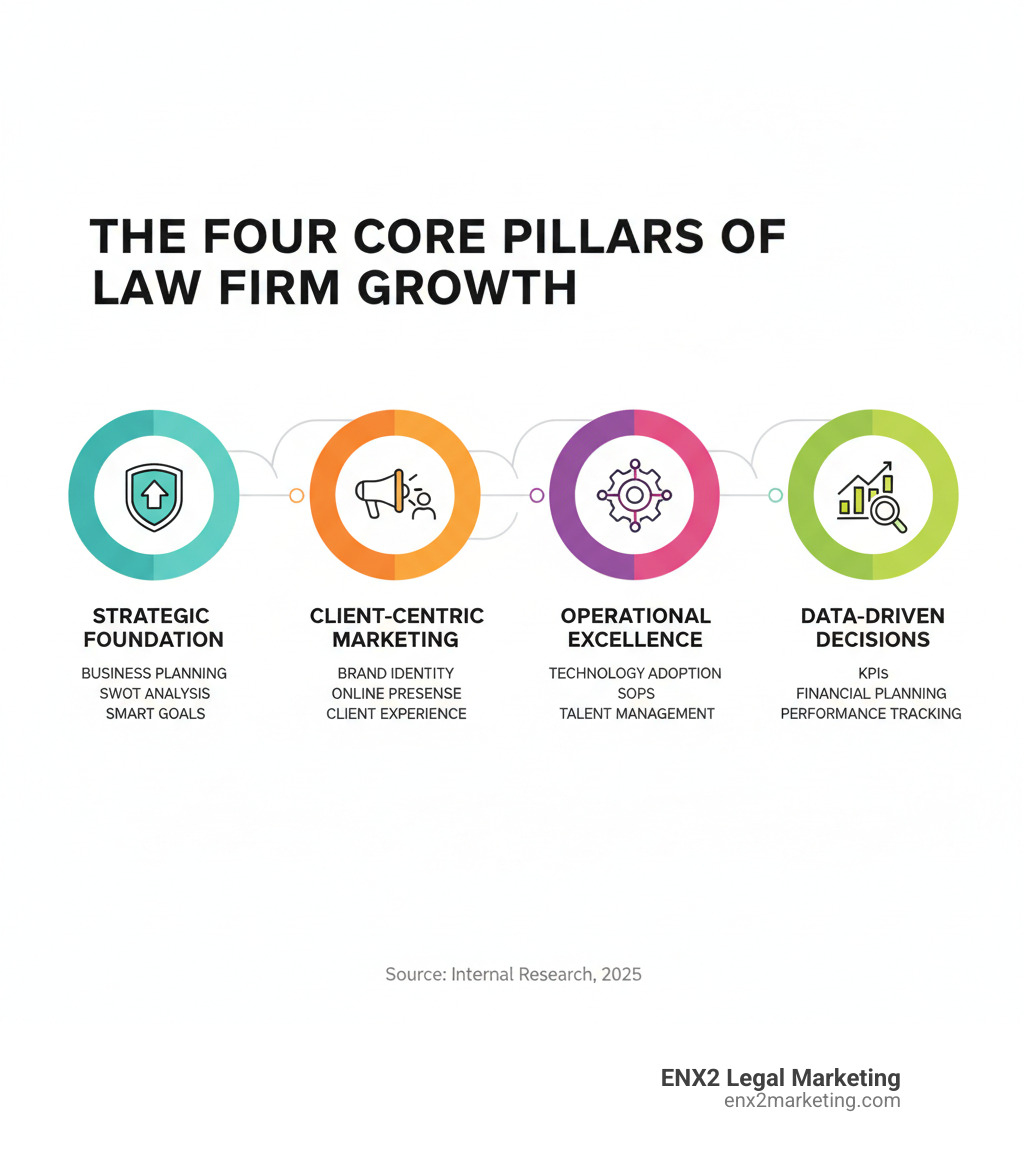
We’ve covered the roadmap for implementing effective law firm growth strategies. Sustainable growth isn’t magic—it’s methodical. It’s the result of intentional planning, consistent execution, and a willingness to treat your practice like the business it is. The firms that thrive combine excellent legal work with smart business strategy, weaving together a solid foundation, client-centric marketing, efficient operations, and data-driven insights.
When you institutionalize these processes, you break free from the exhausting “feast or famine” cycle. So, where does your firm stand? Are you among the 67% of firms that don’t respond to prospect emails? Have you adopted the tech that helps firms earn 20-39% more revenue per lawyer? Do you have a business plan that makes you 30% more likely to hit your goals?
These questions are your starting point. Pick one area and commit to improving it. At ENX2 Legal Marketing, we’ve spent over a decade helping firms across the nation—from Pennsylvania to California—implement these very strategies. We don’t use cookie-cutter solutions. We create customized, data-driven strategies that showcase your firm in innovative ways and position you for measurable growth.
The question isn’t whether you can grow—it’s whether you’re ready to commit to the strategies that make growth inevitable. Your next chapter starts now.
Ready to take that step? Find out more about our law firm data and analytics consulting services and let’s build your growth strategy together. Your firm doesn’t just deserve to survive—it deserves to thrive.