

Why Your Firm’s Next Client is Searching Locally
Law firm local SEO is the practice of optimizing your law firm’s online presence to attract clients in your specific geographic area. When potential clients search for a \”divorce lawyer near me\” or \”personal injury attorney in [city],\” local SEO is what ensures your firm appears prominently in their search results on platforms like Google.
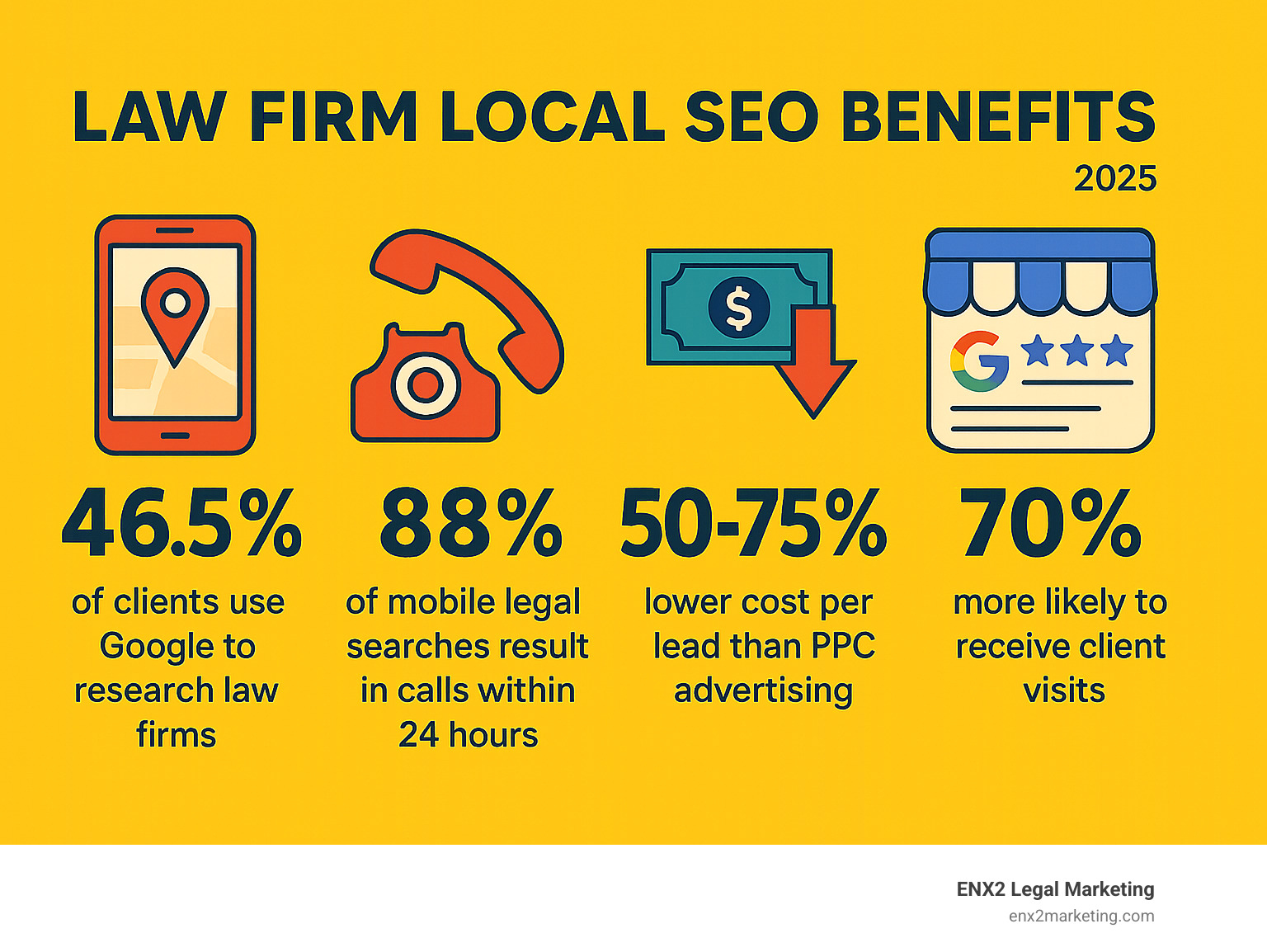
This isn’t a niche strategy; it’s how legal services are found today. The numbers tell a compelling story: 46.5% of prospective clients use Google to research law firms, and a staggering 88% of mobile searches for legal help result in a call within 24 hours. The days of flipping through the Yellow Pages are over. Modern clients start their search online, often with urgent needs and a high intent to hire.
Key Components of Law Firm Local SEO:
- Google Business Profile (GBP) Optimization: This is your digital storefront. A fully optimized GBP includes accurate business hours, services, photos, and posts, making you more visible in the Google Local Pack and on Maps.
- NAP-W Consistency: Ensuring your Name, Address, Phone number, and Website (NAP-W) are identical across all online platforms is a critical trust signal for search engines. Inconsistencies can confuse Google and harm your rankings.
- Local Keyword Targeting: This involves researching and using terms potential clients search for, such as “family law attorney in Brooklyn” or “best DUI lawyer near me.” These keywords should be integrated naturally into your website’s titles, headers, and body content.
- Online Review Management: Positive reviews are modern-day word-of-mouth. Actively encouraging satisfied clients to leave reviews on Google and other legal directories builds social proof and directly impacts your local search ranking.
- Building Local Citations: Citations are mentions of your firm’s NAP on other websites, like legal directories (e.g., Avvo, FindLaw) and local business listings. A robust and consistent citation profile verifies your firm’s legitimacy and location.
- Localized Content Creation: Developing content that speaks directly to your local audience, such as blog posts about changes in state law or city-specific landing pages, demonstrates your local expertise and relevance.
Unlike general SEO, which might target a broad term like “personal injury lawyer,” local SEO focuses on geographic relevance. It helps you rank for “personal injury lawyer in Chicago,” connecting you directly with clients who can actually walk into your office.
I’m Nicole Farber, founder of ENX2 Legal Marketing, and I’ve spent over 12 years helping law firms dominate their local markets. My experience shows that firms investing in a robust law firm local SEO strategy consistently outperform their competitors in both lead quality and client acquisition.
The Ultimate Guide to a Winning Law Firm Local SEO Strategy
When someone faces a legal crisis, they grab their phone and search for help \”near me.\” If your firm isn’t showing up in those crucial moments, you’re invisible to clients who are ready to hire. Legal services are inherently local, tied to specific courts and state laws. Potential clients aren’t just looking for any lawyer; they’re looking for their lawyer, in their area.

Google’s local algorithm connects searchers with the most relevant local businesses by weighing three factors: relevance, distance, and prominence. While you can’t change your distance from a searcher, you have immense power to influence your relevance and prominence. This is where a strategic approach to law firm local SEO becomes your greatest asset.
Your Google Business Profile (GBP) is the cornerstone of your local presence—it’s your digital storefront. A complete, optimized profile makes you 70% more likely to receive client visits. Start by claiming and verifying your profile, then carefully fill out every detail. Choose specific categories like \”Personal Injury Attorney\” over a generic \”Law Firm.\” Add high-quality photos of your team and office, as listings with photos get significantly more engagement. For more tips, see our guide on Attorney Google My Business.
Critically, your firm’s Name, Address, and Phone number (NAP) must be identical across your website, social media, and all online directories. This NAP consistency is a powerful trust signal for search engines. Equally important are online reviews. With 82% of people checking reviews before hiring a lawyer, they are essential for building trust and boosting your visibility. Develop a systematic, ethical process for requesting reviews post-case, and monitor platforms beyond Google, such as Avvo, Yelp, and Facebook. Responding professionally to both positive and negative feedback shows you value client input and are actively engaged. Make it easy for satisfied clients to leave feedback, as Google offers its own best practices for representing your business online.
Next, your website must signal local authority. Create city-specific pages for each location you serve, discussing local legal nuances and mentioning specific courts. Develop detailed practice area pages that answer common client questions within your jurisdiction. Your blog is an opportunity to become a local legal authority by writing about local law changes or community-specific legal issues. Weaving local keywords (e.g., \”car accident attorney near downtown Los Angeles\”) into your titles, headers, and content is key. For a deeper dive, explore our strategies for SEO for Law Firms.
Finally, build your off-site authority. This involves managing citations—mentions of your NAP across the web—to ensure consistency. Our guide on Citation Yellow Pages Law Firm Local SEO can help. You also need to earn local backlinks, which are links from other reputable local websites. Sponsoring local events, partnering with charities, or being featured in local media can generate these powerful “votes of confidence,\” strengthening your firm’s prominence and reputation in the community. The U.S. Small Business Administration also provides excellent guidance on marketing and advertising for local businesses.
Advanced Tactics, Measurement, and Finding Expert Help
Once you’ve mastered the fundamentals, advanced strategies can separate your firm from the competition. These techniques, combined with rigorous measurement, transform your law firm local SEO from a marketing task into a powerful engine for growth.

Advanced technical SEO can give you a significant edge. Implementing Schema markup, specifically LegalService schema, acts as a translator for Google. It explicitly tells search engines about your practice areas, location, and attorney credentials, which can lead to eye-catching rich snippets in search results. Another game-changer is Google Local Services Ads (LSAs). These ads appear at the very top of search results and operate on a pay-per-lead model. By achieving Google Screened status—a verification of your licenses and background—you earn a badge of trust that makes clients far more likely to contact you. You can learn more from Google’s information page on LSAs.
Organic local SEO builds long-term authority, while LSAs provide immediate, high-quality leads. It’s a powerful partnership.
Organic Local SEO vs. Google Local Services Ads: The Perfect Partnership
| Feature | Organic Local SEO | Google Local Services Ads |
|---|---|---|
| Visibility | Ranks in Local Pack and organic results; builds authority over time | Appears at the very top of search results; immediate visibility |
| Cost Model | \”Free\” clicks after initial investment in optimization | Pay-per-lead (only pay for qualified contacts) |
| Trust Signal | Built through reviews, consistency, and website authority | Instant trust through \”Google Screened\” badge |
| Best For | Sustainable, long-term client acquisition and brand building | Immediate lead generation and market penetration |
Investing in local SEO without measuring it is a shot in the dark. The beauty of digital marketing is its measurability. Key Performance Indicators (KPIs) are your compass. Use Google Business Profile Insights to track calls, website clicks, and direction requests. In tools like Google Analytics, monitor website traffic from local searches and track lead generation from contact forms and phone calls. This data allows you to calculate your return on investment and prove how SEO directly contributes to your firm’s bottom line. For more on this, the U.S. Chamber of Commerce offers detailed guidance on using KPIs to measure success.
While some tasks can be handled in-house, the complexity of SEO often makes partnering with an expert agency the smartest path forward. When vetting an agency, prioritize legal industry expertise. A generalist agency won’t understand the ethical requirements and client mindset unique to law firms. Look for a partner who is transparent, communicative, and takes a data-driven approach focused on ROI, not vanity metrics. Be wary of agencies that guarantee rankings or can’t explain their strategy clearly. Ask potential agencies for case studies from law firms in similarly competitive markets. Inquire about their communication and reporting cadence. Key questions to ask include: How do you measure success? What is your approach to link building? Can you explain your strategy for our specific practice areas and geographic location? A trustworthy partner will provide clear, confident answers backed by data.
At ENX2 Legal Marketing, we’ve spent over a decade helping law firms attract more qualified local clients. Headquartered in Pennsylvania with a satellite office in Los Angeles, we work with elite law firms across the nation. Our deep understanding of the legal industry, combined with cutting-edge local SEO strategies, helps firms like yours achieve sustainable growth. To learn more about our comprehensive Law Firm Local SEO services and how we can help you dominate your local market, we invite you to connect with us for a consultation.