Why Your Law Firm’s Website is Under Scrutiny
Law firm website compliance is a critical concern as state bars increasingly treat websites as advertising subject to strict oversight. In today’s digital-first world, a firm’s website is often the primary point of contact for potential clients, making it a powerful, yet regulated, marketing tool. Attorneys are personally and professionally responsible for every word, image, and claim on their site, and failure to comply can lead to serious penalties. Key requirements involve navigating complex attorney advertising rules, displaying necessary disclaimers, ensuring ADA accessibility for users with disabilities, and adhering to evolving data privacy laws.
The stakes are high and continue to rise. With lawsuits against non-compliant websites soaring, firms can no longer afford to treat compliance as an afterthought. State bar regulations vary dramatically; some jurisdictions require pre-filing and registration of websites, while others focus on content, prohibiting unsubstantiated claims, subjective superlatives, or client testimonials that lack proper disclaimers. Furthermore, an inaccessible website not only violates federal law but also excludes the 15% of the world’s population living with a disability—a massive potential client base that includes individuals with visual, auditory, motor, and cognitive impairments.
Your website isn’t just a digital brochure; it’s a regulated advertisement that must balance client attraction with unwavering ethical compliance. As Nicole Farber, founder of ENX2 Legal Marketing, I’ve spent over a decade helping firms steer the complexities of law firm website compliance. I’ve seen how embracing proper compliance improves, rather than restricts, effective and powerful digital marketing. This guide will walk you through the essential steps to ensure your website meets all regulatory standards while ethically and effectively driving client growth.
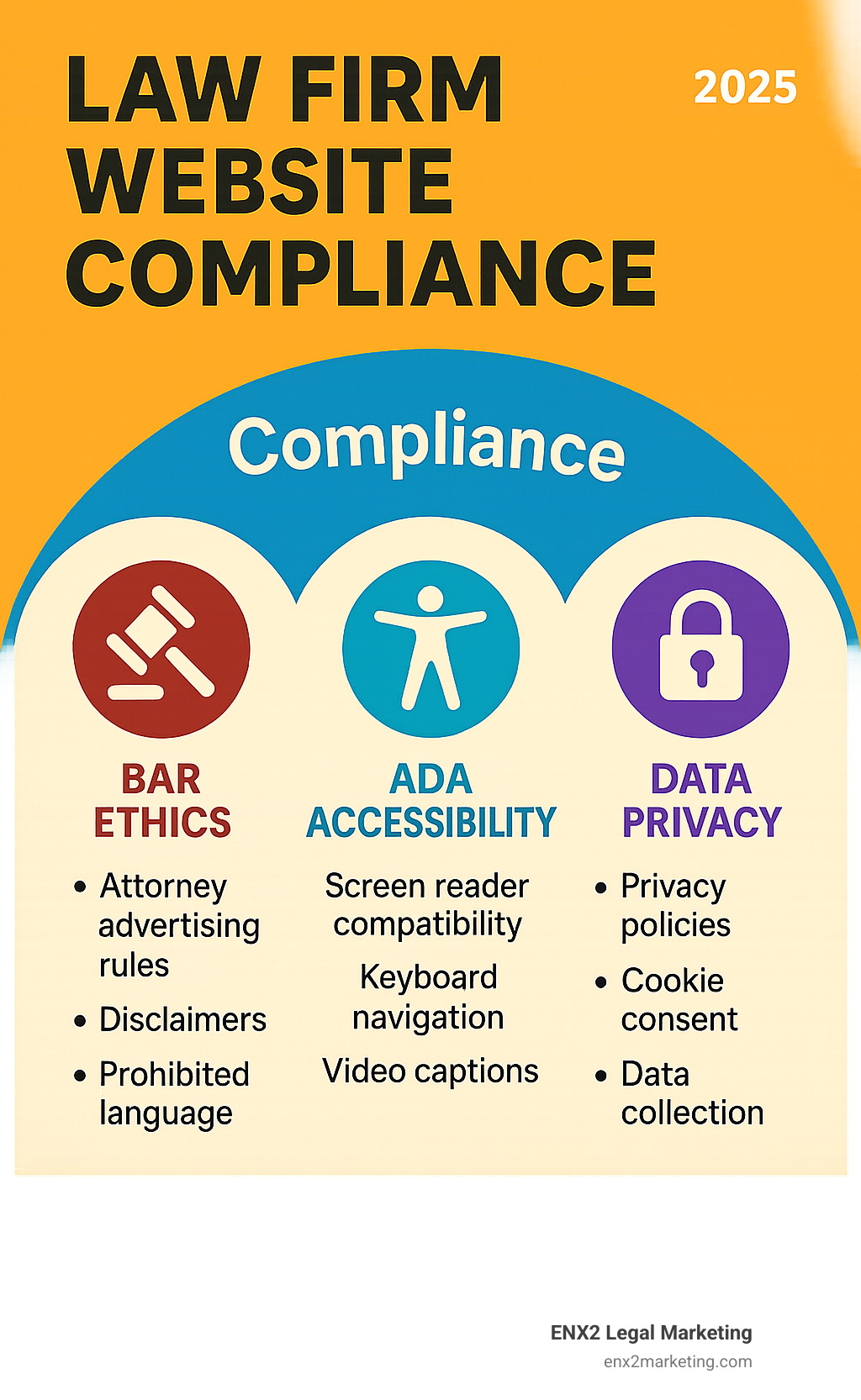

The Core Pillars of Law Firm Website Compliance
Think of law firm website compliance as a three-legged stool supported by attorney advertising ethics, accessibility requirements, and privacy laws. Neglect one, and your entire digital presence is at risk. These pillars create a foundation of trust that protects both your firm and your clients.
Navigating Attorney Advertising and Ethics Rules
Your website is legally considered advertising, meaning every claim, image, and client story falls under strict regulatory oversight. The American Bar Association’s Model Rules of Professional Conduct, particularly Rules 7.1-7.5, provide a national baseline, but each state bar adds its own unique and enforceable spin. The golden rule is attorney responsibility: you are accountable for all content on your site, even if a third-party marketing agency created it. This responsibility cannot be delegated.
Many firms stumble over prohibited language. Words like “expert” or “specialist” are red flags unless you hold a formal certification recognized by your state bar. Similarly, self-praising claims like “best,” “top firm,” or “highest-rated” require objective, verifiable data to back them up. False or misleading statements are broadly interpreted and can include anything that creates an unjustified expectation for a client. Guarantees of outcome (e.g., “we guarantee a win”) are strictly forbidden. While powerful, testimonials and endorsements must be genuine, uncompensated, and accompanied by a clear disclaimer stating that past results do not guarantee future outcomes.

Essential Disclaimers and Disclosures for Your Site
Disclaimers are your legal safety net and are non-negotiable. The most critical are the “not legal advice” and “no attorney-client relationship” disclaimers. These must be clearly visible to clarify that your site offers general information only and that using a contact form or calling the firm does not automatically create a formal relationship. You must also include a jurisdiction disclosure specifying where your attorneys are licensed to practice law, preventing any implication that you can practice in states where you are not admitted.
Many states, like Florida, have physical office location rules requiring a bona fide street address on all advertising, including your website’s header or footer. State-specific rules vary widely. California has strict consumer protection rules governing testimonials and guarantees, while New York requires an “Attorney Advertising” label on the homepage and certain other pages. For detailed guidance, Pennsylvania lawyers can consult the Legal Marketing Rules in Pennsylvania. Finally, be aware of website filing requirements in states like Kentucky and Texas, which may require you to submit a copy of your website and any significant changes to the bar for review.
Beyond Bar Rules: ADA and Privacy Law Mandates
Compliance extends far beyond bar ethics to the Americans with Disabilities Act (ADA) and data privacy laws. The Department of Justice has affirmed that websites are “places of public accommodation,” meaning they must be accessible to people with disabilities. With around 15% of the world’s population has a disability, an inaccessible site is a significant legal liability and a massive lost business opportunity.
Following the Web Content Accessibility Guidelines (WCAG), particularly the Level AA standard, is the key to compliance. This includes providing descriptive alt text for all images, ensuring full keyboard navigation for users who cannot use a mouse, and adding accurate captions and transcripts for videos. On the privacy front, a comprehensive Privacy Policy is non-negotiable. It must detail what data you collect (e.g., names, emails, IP addresses), why you collect it, how it’s stored, and how users can control it. Data collection consent, especially for cookies, requires clear, opt-in mechanisms before you can track users. The Federal Trade Commission: Protecting Consumer Privacy offers robust guidance on these evolving standards. Ignoring these federal mandates can lead to costly demand letters, lawsuits, and severe reputational damage.

Putting Compliance into Practice: An Actionable Checklist
Understanding the rules is one thing; implementing them is another. This section provides an actionable path to audit your site, implement best practices, and partner for sustained, compliant growth.
Auditing and Maintaining Your Law Firm Website Compliance
Law firm website compliance is an ongoing commitment, not a one-time task. The digital and legal landscapes evolve, so you must establish a regular review process for all website content, including blog posts, attorney bios, and case results. Your firm must retain ultimate content ownership and responsibility, even when working with external marketing agencies, to ensure all content adheres to your ethical standards. Furthermore, some jurisdictions require record keeping, meaning you must archive dated copies of your website for several years. Non-compliance can lead to penalties ranging from private reprimands and mandatory ethics courses to public sanctions, fines, suspension, and even disbarment, not to mention severe damage to your firm’s reputation.
Use this 5-step self-audit to stay on track:
- Review Advertising Rules: Scour your site for prohibited language (e.g., “expert,” “specialist,” “unbeatable”) and unsubstantiated claims (e.g., “best,” “most successful”). Ensure any mention of case results includes a prominent disclaimer that past performance does not predict future outcomes.
- Verify Disclaimers: Ensure “not legal advice” and “no attorney-client relationship” disclaimers are prominent, ideally in the website footer on every page. Confirm your physical address and practice jurisdictions are clearly stated and accurate.
- Assess ADA Accessibility: Use a tool like the WAVE Web Accessibility Evaluation Tool to perform a quick scan. Test your site’s usability with keyboard-only navigation (using the Tab key), check that all images have descriptive alt text, and verify that videos have accurate captions or transcripts.
- Confirm Privacy Compliance: Review your Privacy Policy for clarity, accuracy, and completeness. Ensure it details data collection, usage, and user rights. Confirm you have a compliant cookie consent banner that allows users to opt-in before non-essential cookies are placed.
- Monitor Content: Regularly review new content, including blog posts and testimonials, to ensure they are authentic, factually accurate, and make no promises or guarantees. If using stock photos of people, ensure they are not presented in a way that could be mistaken for actual attorneys or clients.
For more on building a compliant content plan, explore our guide on Content Strategy for Law Firms.
Designing for Compliance and Client Experience
A compliant website is an effective website. A mobile-first design is essential, as the majority of potential clients will find you on a smartphone. A responsive site with fast website load speed and intuitive user navigation (UX) not only serves clients better but also improves your Google rankings. You can find authoritative strategies to make your website mobile-friendly directly from Google. Finally, an SSL certificate (HTTPS) is non-negotiable. It encrypts data exchanged between the user’s browser and your server, protecting sensitive information submitted through contact forms. It’s a fundamental requirement for building client trust and a confirmed ranking signal for search engines.
Partnering with Experts for Compliant Digital Growth
Navigating the intricate web of law firm website compliance while trying to grow your practice is a daunting task. At ENX2 Legal Marketing, we specialize in integrating deep compliance knowledge with cutting-edge marketing strategies. We believe ethical rules and accessibility standards aren’t restrictions; they are opportunities to build trust and credibility, which are among the most powerful marketing assets a law firm can possess.
The SEO benefits of compliance are significant and create a positive feedback loop. ADA-friendly features like proper heading structures (H1, H2, H3), descriptive alt text for images, and video transcripts are also SEO best practices that Google’s algorithm rewards. A well-structured, accessible site is easier for search engines to crawl and understand, leading to better visibility. When your website is built correctly from the ground up, your investment in compliance becomes a direct investment in sustainable visibility and growth.
Led by legal marketing expert Nicole Farber, our team has a decade of experience building compliant, high-performing digital assets for elite law firms across the nation, from Pennsylvania and New York to California. Our focus on showcasing your firm in an innovative yet ethical way ensures your website not only attracts the right clients but also stands as a testament to your professionalism. If you’re ready to ensure your website is fully compliant while driving measurable growth, learn more about our specialized lawyer web development services.