



Why Internet Marketing for Law Firm Success is No Longer Optional
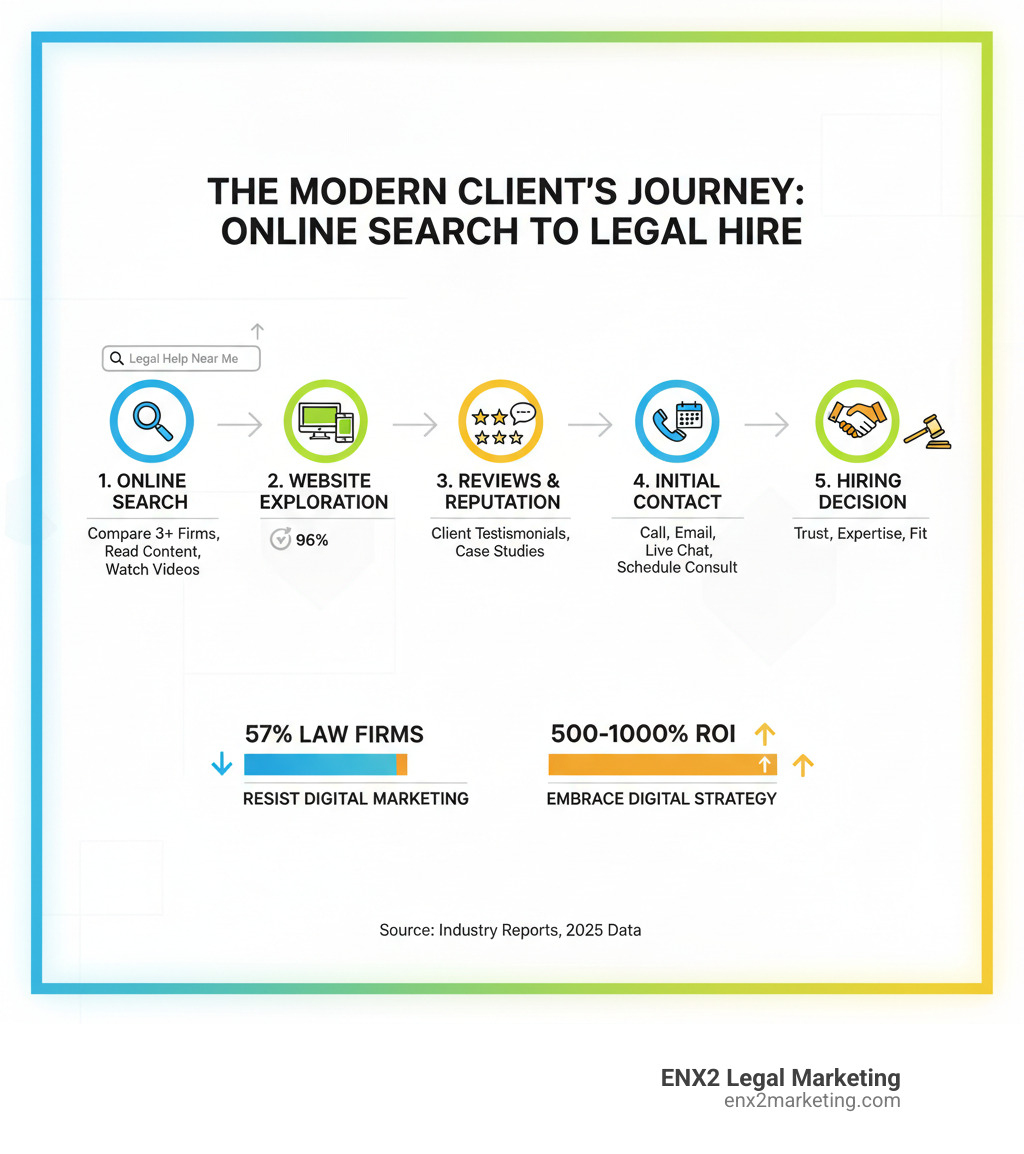
Internet marketing for law firm growth is the primary battleground for client acquisition. If your firm struggles with low website rankings or ineffective marketing, you’re not just falling behind—you’re becoming invisible to the 96% of people who start their search for legal advice online.
Effective internet marketing for law firms includes:
- Search Engine Optimization (SEO) to get found in searches.
- Content Marketing to demonstrate expertise.
- Pay-Per-Click (PPC) Advertising for immediate visibility.
- Local SEO to dominate local search results.
- Reputation Management to build trust with reviews.
- Social Media Marketing to connect with clients.
- Email Marketing to nurture leads and retain clients.
The data is clear: while 57% of firms struggle to get leadership buy-in for digital strategies, those that do report returns of 500% to 1,000% on their investment. Traditional referrals are no longer enough. Your potential clients are comparing multiple law firm websites, reading reviews, and watching videos before ever contacting you. This digital shift allows smaller firms to outrank larger competitors with smart strategies, but it requires expertise.
I’m Nicole Farber, CEO of ENX2 Legal Marketing. For over a decade, I’ve helped law firms steer the complexities of internet marketing for law firm growth. This guide will walk you through the essential strategies your firm needs to attract your ideal clients and win online.

Core Strategies for Internet Marketing for Law Firm Growth
A comprehensive internet marketing for law firm strategy is essential for online visibility and client acquisition.
Building Your Digital Foundation: Website and Search Engine Optimization (SEO)
Your website is your digital storefront, and you have about three seconds to make a good impression. With over 58% of internet traffic on mobile, your site must be mobile-responsive. A slow or broken mobile experience means potential clients will simply hire your competitor. Since 76% of people view three or more law firm websites before making a decision, your site needs clear calls-to-action (CTAs) that guide visitors to contact you.


A great website is useless if no one can find it. That’s where Search Engine Optimization (SEO) comes in. SEO is the process of optimizing your site to rank at the top of search results. While Google’s algorithm considers over 200 factors, focusing on the fundamentals yields major results. On-page SEO involves using relevant keywords and creating content that answers potential clients’ questions. Technical SEO ensures your site is fast, secure (HTTPS), and easily crawlable by search engines.
For law firms, Local SEO is paramount. When someone searches for an attorney “near me,” Google’s local map pack appears in 93% of searches and drives 44% of all clicks. Ranking here can dramatically increase views and inquiries. This requires an optimized Google Business Profile with accurate information, high-quality photos, and a steady stream of client reviews. Beyond Google, your firm’s Name, Address, and Phone number (NAP) must be identical across all online directories and legal citation sites. These consistent listings, known as citations, act as votes of confidence for search engines, validating your location and legitimacy. Any inconsistency can confuse Google and significantly hurt your local ranking.
Content Marketing: The Cornerstone of Internet Marketing for a Law Firm
Content marketing builds trust by answering your potential clients’ most pressing questions. It’s about being a helpful resource, not a pushy salesperson. A blog with FAQs, legal glossaries, and how-to guides establishes your authority and improves SEO by targeting valuable keywords.

Video marketing is a powerful, underused tool. Websites with video are 53 times more likely to reach Google’s first page, and video on landing pages can increase conversions by 80%. More importantly, video humanizes your firm, allowing potential clients to see and hear you, building rapport before they even call.
Because legal topics are considered “Your Money or Your Life” (YMYL), Google holds your content to a higher standard of Expertise, Authority, and Trustworthiness (E-A-T). All content must be accurate, well-researched, and written by credible professionals, while adhering to ethical guidelines.
Paid Advertising (PPC) in Internet Marketing for a Law Firm
While SEO builds long-term authority, Pay-Per-Click (PPC) advertising delivers immediate traffic. It’s the difference between planting a garden and buying groceries.
In short: SEO compounds over time and can drive “free” clicks after you invest in content and optimization; it’s highly credible but offers less immediate control. PPC provides instant visibility and precise control over budget, keywords, locations, and timing—but you pay per click, and some consumers are skeptical of ads .
PPC’s main advantage is immediate lead generation through platforms like Google Ads. You can target users with incredible precision based on keywords, location, and demographics. However, the legal market is one of the most expensive for PPC, with some keywords costing hundreds of dollars per click. This makes strategic budget management, including the use of negative keywords to filter out irrelevant searches, absolutely essential. Furthermore, a successful PPC campaign doesn’t just stop at the click; it directs users to a dedicated, high-converting landing page designed specifically for that ad. Without an optimized landing page, you’re essentially paying to send valuable traffic to a dead end. PPC works best as part of a comprehensive strategy, not as a standalone solution.
Reputation Management, Social Media, and Email Marketing
Your online reputation is critical. A staggering 93% of consumers read reviews before making a purchase, and 58% would pay more for a business with high ratings.

Online reputation management involves actively encouraging and responding to client reviews on your Google Business Profile and legal directories like Avvo and Justia. A professional response to even a negative review can demonstrate your commitment to client satisfaction.
A strong social media presence amplifies your content and drives website traffic. LinkedIn is ideal for B2B services and thought leadership, while Facebook is excellent for community engagement and targeted ads. Even platforms like Instagram and TikTok can humanize your brand and reach younger audiences. The key is consistency and genuine engagement.
Finally, don’t overlook email marketing strategies, which can deliver an ROI of up to 4,200%. Use email to nurture leads with helpful content and retain past clients with newsletters, keeping your firm top-of-mind for future needs and referrals. Segmenting your lists allows for highly personalized and effective messaging.
Measuring ROI and Partnering for Success
Let’s be honest—you didn’t go to law school to become a marketing analyst. But any effective internet marketing for law firm strategy absolutely needs robust measurement. Without data, you’re essentially spending blindly.
The key is tracking the right Key Performance Indicators (KPIs). While metrics like website traffic and keyword rankings are important for gauging visibility, the metrics that truly matter are tied to new business. Track conversion rates—the percentage of visitors who take a desired action, like filling out a contact form or calling your office. To do this accurately, you must implement conversion tracking and even call tracking software, which assigns unique phone numbers to different marketing campaigns. This allows you to know exactly which ads, pages, or channels are generating calls. From there, you can calculate your Cost Per Lead (CPL) (total marketing spend divided by the number of leads) and, most importantly, your Cost Per Acquisition (CPA) (total spend divided by the number of new clients signed). Understanding these figures is the only way to know what you’re truly spending to get a new client and measure the campaign’s profitability.
Calculating ROI tells the real story. A 5:1 revenue-to-cost ratio is considered good, but for well-executed internet marketing for law firm campaigns, a 500% to 1,000% ROI is common. If a $2,000 campaign generates two new cases worth $20,000 each, you’ve turned $2k into $40k—a massive return.
The challenge is that implementing and managing these strategies requires significant time and expertise. Between cases, court dates, and running a practice, most attorneys can’t also become experts in Google’s algorithm or PPC bid management. This is why 41% of firms find it difficult to keep up with rapid changes in marketing technology.
This is where partnering with a specialized agency makes sense. At ENX2 Legal Marketing, we’ve spent over a decade handling the complexities of legal marketing so our clients can focus on practicing law. We craft customized strategies for firms of all sizes, from solo practitioners to elite national firms, generating over 1,000,000 leads for our clients. We know what it takes to move the needle.
Your potential clients are searching for you right now. The question isn’t whether to invest in your online future, but whether you’ll do it strategically.
Don’t let your firm get left behind in the digital dust. Get a custom bankruptcy lawyer website design that converts and start attracting the clients you deserve.