


Are logo parodies legal? Risky 2025 Guide
The Allure and Risk of Parody Logos
Are logo parodies legal? This question echoes through creative agencies, activist groups, and small businesses alike. In an age of memes, social commentary, and brand-conscious consumers, the parody logo has become a powerful tool for expression. Yet the answer isn’t a simple yes or no. Logo parodies sit in a legal gray area where free speech intersects with trademark protections—offering immense creative opportunity alongside real legal risk.
For anyone looking to create or use a parody logo, understanding this balance is critical. Here’s a quick breakdown of the core issues:
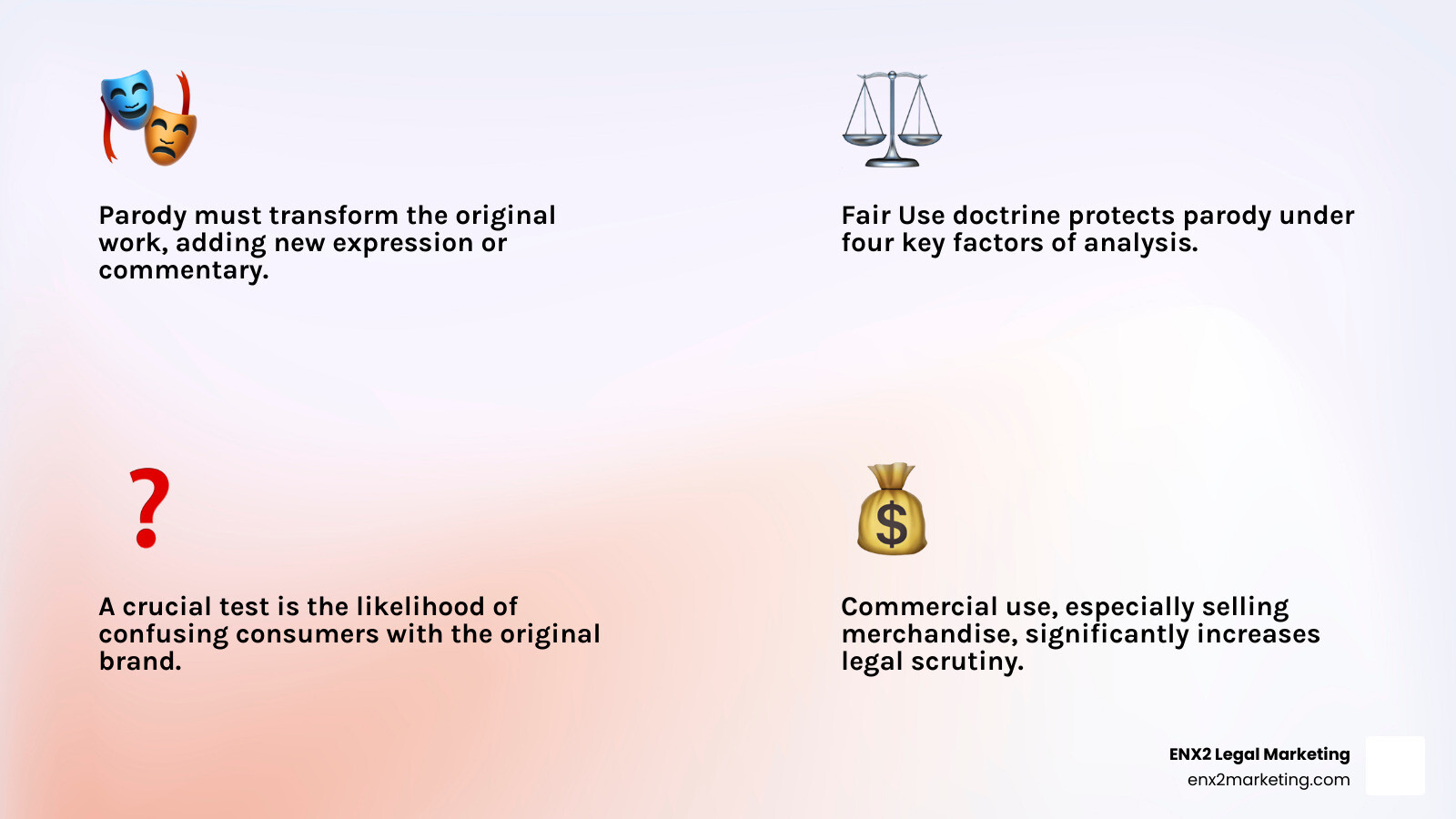
- Generally Legal for Commentary: Parody is a form of commentary or criticism, protected by the First Amendment. When a parody logo comments on the original brand, its products, or corporate behavior, it often has a strong legal foundation. The law recognizes that meaningful criticism sometimes needs to invoke the target’s own language and imagery to be effective.
- Key Requirement: Change: A defensible parody is transformative. It can’t just copy; it must add new expression, meaning, or message. It should be clear to an ordinary observer that it’s a joke or critique—not the real thing. That transformative element is what separates protected parody from straightforward infringement.
- Heightened Risk with Commercial Use: The legal calculus changes when you sell merchandise featuring a parody logo. Courts scrutinize commercial use more closely because the potential for consumer confusion—and the parodist benefiting from the brand’s goodwill—is higher. Selling a T‑shirt with a parody logo is treated very differently from using it in a political cartoon.
- No Guaranteed Protection: There’s no formula that guarantees a parody is legal. Outcomes depend on specific facts, jurisdiction, and the judge. Courts weigh factors such as the likelihood of confusion to decide whether a parody crosses into trademark infringement. One court’s harmless joke can be another’s damaging dilution.
- The Safest Approach: Given the stakes and ambiguity, consult an intellectual property attorney before launching a commercial product or high‑profile campaign featuring a parody logo. Proactive advice is far less expensive than reactive litigation.
Logo parodies are part of modern culture, from viral memes and sketch comedy that lampoon corporate branding to activist campaigns that subvert logos like BP’s (British Petroleum turned into “Brutish Polluters”) to highlight environmental or social issues. These works test the line between protected speech and infringement. They can be funny, biting, and culturally significant—letting society “talk back” to powerful brands.
But the legal landscape is a minefield. While the First Amendment shields genuine commentary, trademark owners have robust tools to protect against dilution, tarnishment, and consumer confusion. Companies invest heavily in brand recognition and goodwill, and often defend their marks aggressively. A poorly executed parody can quickly draw a cease-and-desist letter. If ignored, that can escalate to a federal lawsuit seeking an injunction, the seizure and destruction of goods, and monetary relief—potentially including profits, damages, and sometimes attorney’s fees.
As Nicole Farber, CEO of ENX2 Legal Marketing, I’ve spent over a decade at the intersection of law and marketing, guiding firms through trademark disputes where the core question is are logo parodies legal. Without a clear grasp of the legal framework, a clever creative can inadvertently become trademark infringement—with serious consequences for artists, entrepreneurs, and activists. This article helps you navigate that fine line.

Are Logo Parodies Legal? The Core Legal Principles
When we ask are logo parodies legal, we’re delving into a fascinating intersection of humor, art, and intellectual property law. It’s a highly nuanced area where context is everything, and the specific details of the parody can make the difference between a protected piece of commentary and a costly infringement lawsuit. Understanding the core legal principles that courts use to analyze these cases is the first and most crucial step toward creating a defensible parody and avoiding a legal headache.
Defining Parody vs. Satire in Intellectual Property Law
The first, and perhaps most critical, legal distinction you must grasp is the difference between parody and satire. While both often employ humor and wit, their legal treatment under both copyright and trademark law can be worlds apart. Many creators mistakenly believe any humorous use of a logo is a protected “parody,” but courts apply a much more specific definition. Getting this wrong is a common pitfall that can doom a parody defense from the start.
What constitutes a parody logo in the context of intellectual property law?
A parody, in the legal sense, is a work that specifically targets an existing, well-known logo or brand to comment on or criticize it. The core purpose of the parody is to make fun of, critique, or hold up to ridicule the original work itself or the company it represents. To qualify as a true parody, the new work must achieve a delicate balance: it must conjure up the original logo enough for the audience to recognize what is being targeted, but it must also be different enough that it is clearly a new, “transformative” work and not just a copy. This dual message—”here is the original, and here is my commentary on it”—is the hallmark of a legally protected parody. For example, the brand “The South Butt” was a successful parody of “The North Face” because it directly poked fun at the original’s branding, adventurous image, and culture of outdoor elitism.
What is the difference between parody and satire in relation to fair use and copyright law?
This is where the legal lines become sharper, and where many would-be parodists get into trouble. The Supreme Court, in the landmark copyright case Campbell v. Acuff-Rose Music, Inc., drew a clear and influential distinction that has been widely adopted in trademark cases as well. The case involved 2 Live Crew’s parody of Roy Orbison’s song “Oh, Pretty Woman.” The court’s analysis provides the framework we use today.
- Parody: A parody must borrow from the original work to make its point. As the Supreme Court stated, it “has to mimic an original to make its point, and so has some claim to use the creation of its victim’s (or collective victims’) imagination.” The humor or criticism of a parody is directed inward, at the original. Think of “Weird Al” Yankovic’s songs; they are nonsensical without knowledge of the original songs they are mocking. This necessity to borrow gives parody a stronger claim under the fair use doctrine because the use of the original material is integral to the new work’s expressive purpose.
- Satire: A satire, on the other hand, uses a work as a weapon to criticize something else entirely—a broader societal issue, a political figure, or general human folly. It could stand on its own two feet but chooses to use the famous work to get more attention or to make its commentary more pungent. For example, using a modified Coca-Cola logo to comment on an unrelated political issue would be satire. Because the satire isn’t commenting on Coca-Cola itself, its justification for borrowing the company’s valuable intellectual property is much weaker. The original work is just a convenient vehicle, not the actual target.
In short, parody needs to reference the original to be understood, whereas satire merely uses the original as a vehicle for a different message. This distinction is vital because courts consistently give more leeway to parody under fair use and First Amendment analyses. As a result, parody is a recognized defense to trademark infringement, while satire is not. If your work is deemed a satire, your defense against an infringement claim becomes significantly more difficult.
Here’s a quick comparison to clarify the concepts:
| Feature | Parody | Satire |
|---|---|---|
| Primary Target | The original work or brand itself. | A broader societal issue, person, or idea. |
| Purpose | To comment on or criticize the original. | To use the original’s fame to comment on something else. |
| Legal Justification | Strong. Must borrow from the original to make its point. | Weak. Does not need to borrow from the original to be understood. |
| Fair Use Strength | Generally stronger claim to fair use. | Generally weaker claim to fair use. |
| Example | Changing the “Burger King” logo to “Murder King” to protest the company’s meat-sourcing practices. | Using the “Burger King” logo in a political cartoon to mock a politician’s policies, without any comment on the brand itself. |